August delivers the crown jewel of summer skywatching. As twilight arrives earlier each evening, backyards turn into front-row seats for deep-space sights, bright planetary meetups, and one of the best dark-sky meteor setups in years.
Whether you are stepping outside with your bare eyes from a blanket in the lawn or setting up a telescope, August 2026 brings an exciting mix of cosmic wonders. Here is your guide to navigating the warm midsummer night sky!
August 12–13: The Grand Moonless Perseids Peak
Mark your calendar for the overnight hours of August 12 into the predawn of August 13. The annual Perseid Meteor Shower reaches its peak, and 2026 presents the absolute best setup possible: a New Moon on August 12.
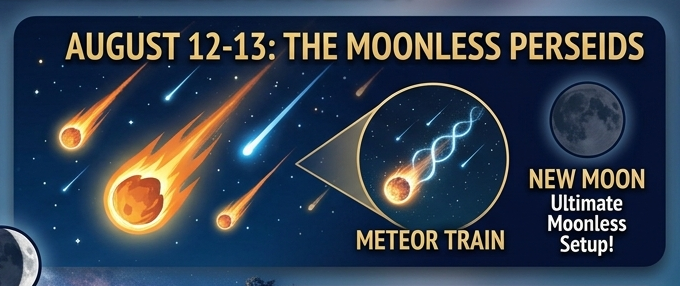
With no moonlight to wash out fainter streaks, observers under dark rural skies can spot up to 60 to 100 meteors per hour! The Perseids are particles shed by Comet Swift-Tuttle. As these tiny pebbles hit Earth’s upper atmosphere at roughly 37 miles per second, they produce intense, swift flashes of light.
Stargazing Tip for the Perseids
You do not need a telescope to enjoy the Perseids! In fact, your bare eyes are the best tool because they offer a wide field of view.
- When to watch: Midnight through predawn on August 13 offers the highest meteor counts.
- Where to look: Lie back in a comfortable lawn chair facing northeast toward the constellation Perseus.
- Bonus sight: Keep an eye out for fireballs—exceptionally bright meteors that leave behind persistent “meteor trains” (glowing ionization trails drifting in upper winds).
August 15: Venus Reaches Greatest Eastern Elongation
If you look west about 45 minutes after sunset throughout early August, Venus dominates as the brilliant “Evening Star”.
On August 15, Venus reaches its Greatest Eastern Elongation, placing it at its maximum angular distance from the Sun as seen from Earth. Because it sits far to the left of the solar glare, Venus remains illuminated high above the western horizon well into twilight.
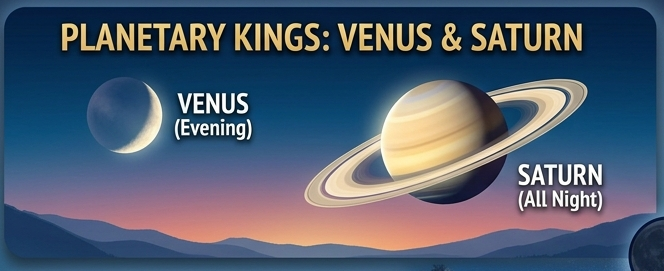
If you point binoculars or a small telescope at Venus around this time, you will notice it doesn’t look like a solid circle; instead, it shines like a tiny, brilliant half-Moon!
Mid-to-Late August: Saturn Returns to Prominence
While Venus rules the sunset, Saturn takes center stage for late-night skywatchers. Rising in the east-southeast late in the evening, the ringed planet shines with a steady, golden glow.
How to Observe Saturn
- Naked Eye: Unlike stars, which twinkle rapidly, Saturn shines with a calm, unblinking light.
- Small Telescope / Binoculars: A magnification of just 25x to 30x reveals Saturn’s iconic ring system suspended in space, along with its largest, brightest moon, Titan.
Deep Sky Tour: The Summer Triangle and Andromeda
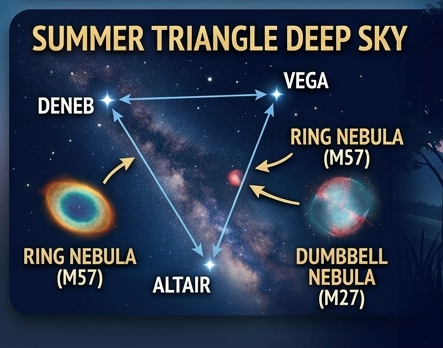
August is prime time for sweeping the Milky Way band overhead. Face high overhead to spot the Summer Triangle, anchored by three bright stars: Vega (in Lyra), Deneb (in Cygnus), and Altair (in Aquila).
Deep Sky Highlights
- The Ring Nebula (Messier 57): Tucked inside Lyra, this expanding shell of gas from a dying star looks like a tiny glowing smoke ring through modest backyard optics.
- The Great Hercules Cluster (Messier 13): Look west of Vega toward the constellation Hercules to spot a densely packed ball containing hundreds of thousands of ancient stars.
- The Andromeda Galaxy (Messier 31): As midnight approaches, look east below Cassiopeia. Situated 2.5 million light-years away, Andromeda is the most distant object human eyes can see without optical aid under dark skies!
August 27–28: The Late-Summer Partial Lunar Eclipse
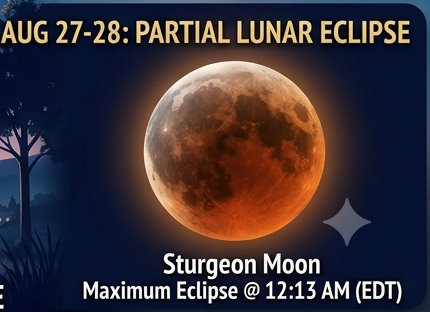
The month closes with a lunar event! On the night of August 27 into the early morning of August 28, the Full “Sturgeon” Moon passes directly through the outer portion of Earth’s shadow, resulting in a Partial Lunar Eclipse.
Unlike a solar eclipse, a lunar eclipse is 100% safe to view with the naked eye! During the peak of the eclipse, Earth’s dark central shadow (the umbra) will bite into the lunar disc, giving the Moon a distinct, dusky appearance.
| Stage | Event Timing (EDT) | What to Look For |
| Penumbral Start | ~3:33 AM | Faint darkening along the Moon’s edge |
| Partial Shadow Begins | ~4:10 AM | Earth’s dark umbral shadow begins covering the Moon |
| Maximum Eclipse | ~5:12 AM | Up to 90% of the Moon shaded in deep shadow |
Gear Toolkit for August Stargazing
To get the most out of your late-summer observing sessions, a few simple accessories will keep you comfortable and dark-adapted:
- Red LED Headlamp: Keep your night vision intact while reading star maps with a dual-mode EverBrite Ultra Bright Red LED Headlamp.
- Star Chart / Planisphere: Locate constellations effortlessly using a double-sided Night Sky Planisphere Star Chart.
- Wide-Angle Eyepiece: If you use a manual reflector or Dobsonian telescope, upgrade your field of view with a wide-angle SV
- BONY 2-Inch 34mm Eyepiece to capture sprawling targets like M31 or the Perseid trains.
Summary of Key August 2026 Skywatching Events
| Date | Celestial Event | Best Time to Watch | Looking Direction |
| Aug 12 | New Moon (Dark Sky Night) | All Night | Skywide |
| Aug 12–13 | Perseid Meteor Shower Peak | Midnight to Dawn | Northeast (Perseus) |
| Aug 15 | Venus at Greatest Elongation | Dusk / Post-Sunset | Low West |
| Aug 20 | First Quarter Moon | Evening twilight | South-Southwest |
| Aug 27–28 | Partial Lunar Eclipse & Full Moon | 3:30 AM – 5:30 AM EDT | Southwest |
For a visual breakdown of how to star-hop to the Summer Triangle targets and prepare for the Perseid peak, check out this helpful August 2026 Night Sky Video Guide.
This video provides an excellent visual calendar of the major August 2026 celestial events, making it easy to plan your family observing nights.
Clear skies, keep your red lights ready, and enjoy late-summer stargazing!

