August 2026 Night Sky Guide: Fireballs, Planetary Kings, and the Late-Summer Eclipse

August delivers the crown jewel of summer skywatching. As twilight arrives earlier each evening, backyards turn into front-row seats for deep-space sights, bright planetary meetups, and one of the best dark-sky meteor setups in years.

Whether you are stepping outside with your bare eyes from a blanket in the lawn or setting up a telescope, August 2026 brings an exciting mix of cosmic wonders. Here is your guide to navigating the warm midsummer night sky!

August 12–13: The Grand Moonless Perseids Peak

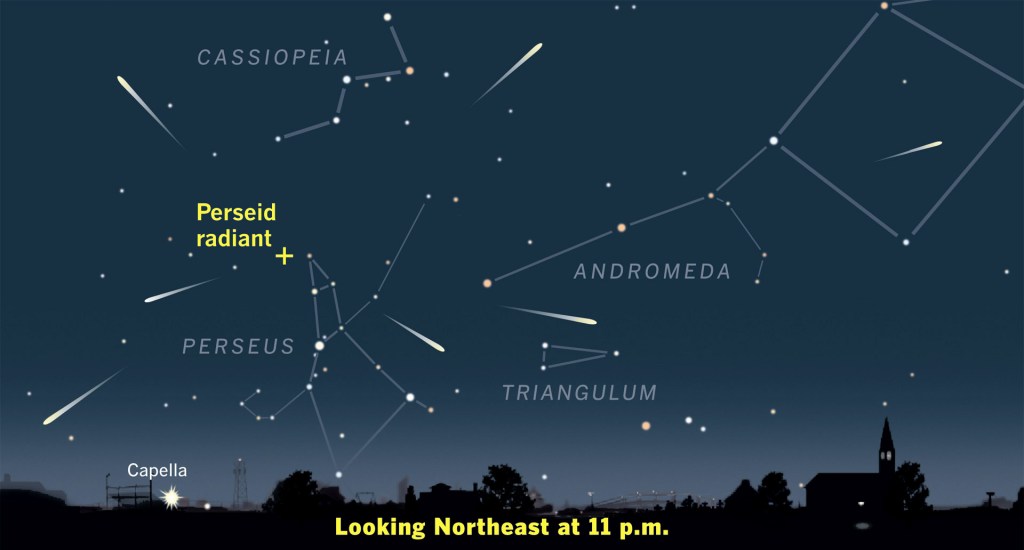
Mark your calendar for the overnight hours of August 12 into the predawn of August 13. The annual Perseid Meteor Shower reaches its peak, and 2026 presents the absolute best setup possible: a New Moon on August 12.
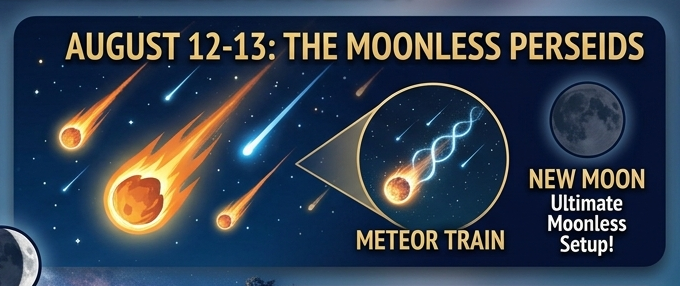
With no moonlight to wash out fainter streaks, observers under dark rural skies can spot up to 60 to 100 meteors per hour! The Perseids are particles shed by Comet Swift-Tuttle. As these tiny pebbles hit Earth’s upper atmosphere at roughly 37 miles per second, they produce intense, swift flashes of light.

Stargazing Tip for the Perseids

You do not need a telescope to enjoy the Perseids! In fact, your bare eyes are the best tool because they offer a wide field of view.

  • When to watch: Midnight through predawn on August 13 offers the highest meteor counts.
  • Where to look: Lie back in a comfortable lawn chair facing northeast toward the constellation Perseus.
  • Bonus sight: Keep an eye out for fireballs—exceptionally bright meteors that leave behind persistent “meteor trains” (glowing ionization trails drifting in upper winds).

August 15: Venus Reaches Greatest Eastern Elongation

If you look west about 45 minutes after sunset throughout early August, Venus dominates as the brilliant “Evening Star”.

On August 15, Venus reaches its Greatest Eastern Elongation, placing it at its maximum angular distance from the Sun as seen from Earth. Because it sits far to the left of the solar glare, Venus remains illuminated high above the western horizon well into twilight.
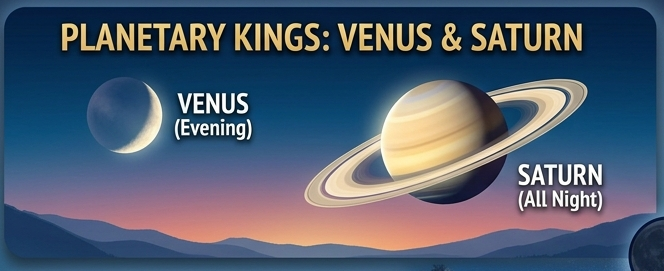
If you point binoculars or a small telescope at Venus around this time, you will notice it doesn’t look like a solid circle; instead, it shines like a tiny, brilliant half-Moon!

Mid-to-Late August: Saturn Returns to Prominence

While Venus rules the sunset, Saturn takes center stage for late-night skywatchers. Rising in the east-southeast late in the evening, the ringed planet shines with a steady, golden glow.

How to Observe Saturn

  • Naked Eye: Unlike stars, which twinkle rapidly, Saturn shines with a calm, unblinking light.
  • Small Telescope / Binoculars: A magnification of just 25x to 30x reveals Saturn’s iconic ring system suspended in space, along with its largest, brightest moon, Titan.

Deep Sky Tour: The Summer Triangle and Andromeda

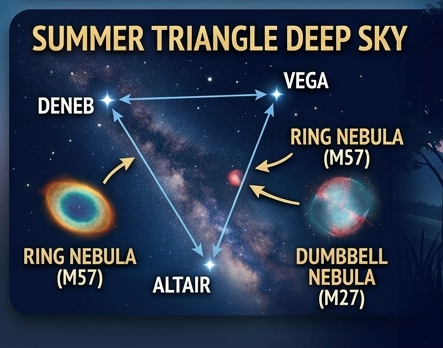
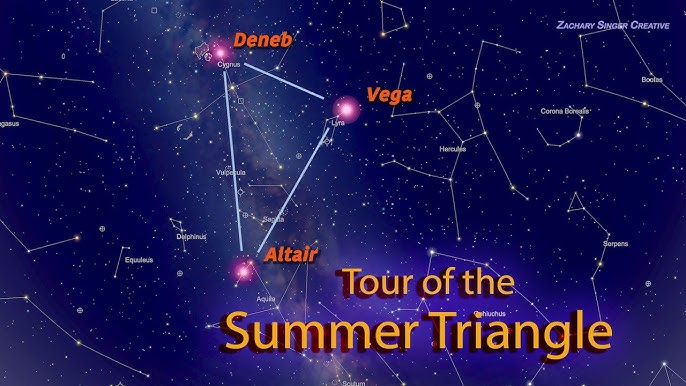
August is prime time for sweeping the Milky Way band overhead. Face high overhead to spot the Summer Triangle, anchored by three bright stars: Vega (in Lyra), Deneb (in Cygnus), and Altair (in Aquila).
Deep Sky Highlights

  • The Ring Nebula (Messier 57): Tucked inside Lyra, this expanding shell of gas from a dying star looks like a tiny glowing smoke ring through modest backyard optics.
  • The Great Hercules Cluster (Messier 13): Look west of Vega toward the constellation Hercules to spot a densely packed ball containing hundreds of thousands of ancient stars.
  • The Andromeda Galaxy (Messier 31): As midnight approaches, look east below Cassiopeia. Situated 2.5 million light-years away, Andromeda is the most distant object human eyes can see without optical aid under dark skies!

August 27–28: The Late-Summer Partial Lunar Eclipse
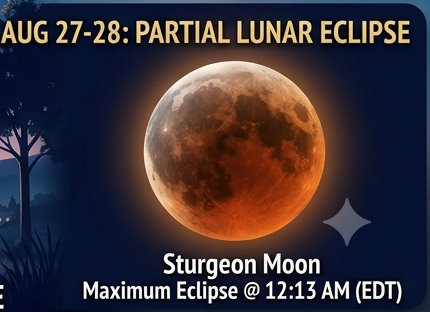
The month closes with a lunar event! On the night of August 27 into the early morning of August 28, the Full “Sturgeon” Moon passes directly through the outer portion of Earth’s shadow, resulting in a Partial Lunar Eclipse.

Unlike a solar eclipse, a lunar eclipse is 100% safe to view with the naked eye! During the peak of the eclipse, Earth’s dark central shadow (the umbra) will bite into the lunar disc, giving the Moon a distinct, dusky appearance.

StageEvent Timing (EDT)What to Look For
Penumbral Start~3:33 AMFaint darkening along the Moon’s edge
Partial Shadow Begins~4:10 AMEarth’s dark umbral shadow begins covering the Moon
Maximum Eclipse~5:12 AMUp to 90% of the Moon shaded in deep shadow

Gear Toolkit for August Stargazing

To get the most out of your late-summer observing sessions, a few simple accessories will keep you comfortable and dark-adapted:

Summary of Key August 2026 Skywatching Events

DateCelestial EventBest Time to WatchLooking Direction
Aug 12New Moon (Dark Sky Night)All NightSkywide
Aug 12–13Perseid Meteor Shower PeakMidnight to DawnNortheast (Perseus)
Aug 15Venus at Greatest ElongationDusk / Post-SunsetLow West
Aug 20First Quarter MoonEvening twilightSouth-Southwest
Aug 27–28Partial Lunar Eclipse & Full Moon3:30 AM – 5:30 AM EDTSouthwest

For a visual breakdown of how to star-hop to the Summer Triangle targets and prepare for the Perseid peak, check out this helpful August 2026 Night Sky Video Guide.

This video provides an excellent visual calendar of the major August 2026 celestial events, making it easy to plan your family observing nights.

Clear skies, keep your red lights ready, and enjoy late-summer stargazing!
The Ultimate Summer Space Race: Your Night-by-Night Cosmic Scavenger Hunt (July & August 2026 Edition)

Are you ready to turn your backyard into a launching pad for interstellar discovery? This summer, we are hosting the ultimate Summer Space Race! Whether you are a parent looking for an exciting, screen-free family project or a seasoned visual observer eager to test the limits of your optics, this progressive, night-by-night scavenger hunt is built just for you.

We have broken this challenge into two parallel tracks that build in excitement from one target to the next:

  • The Starlight Cadet Track: Perfect for families, beginners, and anyone using the naked eye or a pair of entry-level binoculars.
  • The Cosmic Veteran Track: Tailored for experienced backyard astronomers with manual or motorized telescopes who love a good tracking challenge.

Grab your red-lens flashlights, head out to your favorite local dark-sky park, and let the space race begin!

Part 1: The July Warm-Up – Cosmic Alignments & The Teapot

Our scavenger hunt begins in July as the summer Milky Way rises high in the southern sky. To find the best views, consider taking a family trip to a certified international dark-sky location or a national park near you to escape city light pollution.

Level 1: The Planetary Gateway (July 11, 2026)

  • Starlight Cadet Challenge: Wake up early! Two hours before sunrise, look toward the eastern horizon. Your mission is to locate the thin crescent Moon forming a striking celestial triangle with the bright orange spark of Mars and the sparkling, pale-blue fuzzy patch of the Pleiades Star Cluster. Can you see all three within a single glance?
  • Cosmic Veteran Challenge: Center your telescope on that tight cosmic trio. Use a wide-field eyepiece to capture Mars and the Pleiades in the same frame. For an advanced astrophotography goal, try a long-exposure stack to reveal the delicate reflection nebulosity surrounding the Pleiades stars right next to the planetary glow of Mars.

Level 2: Steaming Up the Milky Way (July 14, 2026 – New Moon)

  • Starlight Cadet Challenge: With the moon completely dark tonight, look due south to find the constellation Sagittarius. Look for the famous “Teapot” asterism. Once you spot the spout of the teapot, look closely—can you see the thick, cloudy band of our Milky Way galaxy appearing to “steam” right out of the spout?
  • Cosmic Veteran Challenge: Use the Teapot’s spout as your jumping-off point to hunt down the Lagoon Nebula (Messier 8) and the Trifid Nebula (Messier 20). For a true test of manual navigation, attempt to split the three distinct dust lanes of the Trifid using a high-quality UHN/O-III nebula filter.

🛒 Gear Upgrade: If you want to make the jump from naked-eye viewing to crisp celestial details, a durable pair of waterproof binoculars is the perfect family companion. For deep-sky hunting, a classic, high-light-gathering reflector telescope provides unmatched views of nebulas without breaking the bank.

For Astronomy products please check the links for Amazon and OpticsPlanet.com

Part 2: The August Peak – Meteors, Eclipses, and Deep-Space Gems

August 2026 is bringing some of the most spectacular, pristine astronomical conditions of the decade. The moon is cooperating perfectly for the year’s best celestial fireworks.

Level 3: Navigating the Summer Triangle

  • Starlight Cadet Challenge: Look straight up after dark to find the three brightest stars of summer: Vega, Altair, and Deneb. Congratulations, you’ve found the Summer Triangle! Now, look closer at Altair—did you know this young star spins so fast (once every 8 hours) that it’s actually flattened like a squished beach ball?
  • Cosmic Veteran Challenge: Dive inside the Summer Triangle to locate Messier 27 (The Dumbbell Nebula), the first planetary nebula ever discovered. Once you’ve checked that off your list, slide over to Cygnus and manually star-hop your way to the Veil Nebula. Can you resolve the delicate, wispy shockwaves of this ancient supernova remnant?

Level 4: The Moonlight-Free Finale (August 12–14, 2026)

This is the peak of the Summer Space Race. On August 12, parts of the world will witness a historic solar eclipse. Then, on the nights of August 12 and 13, the legendary Perseid Meteor Shower peaks under a 0% illumination New Moon—meaning absolute darkness!

  • Starlight Cadet Challenge: Find an open field, spread out a blanket, lay flat on your back, and look up toward the constellation Perseus. Because the sky is perfectly dark this year, count how many shooting stars you can spot in a single hour. Keep an eye out for “fireballs”—extra bright meteors that leave glowing smoke trails across the sky!
  • Cosmic Veteran Challenge: This is the ultimate astrophotography challenge of the summer. Set up your camera with a wide-angle lens, attach it to a reliable star tracker, and program an intervalometer to capture continuous exposures throughout the night. Your goal? Capture a single, high-definition composite frame showing multiple Perseid meteors radiating outwards from the constellation Perseus against a sharp, tracked background of the Milky Way core.

The Space Race Scorecard

Track your family’s progress through the summer using our quick checklist:

Target LevelStarlight Cadet GoalCosmic Veteran GoalDate to AttemptCompleted?
Level 1Spot Moon, Mars, & PleiadesImage Mars & Pleiades togetherJuly 11[ ]
Level 2Locate the Sagittarius “Teapot”Manually resolve the Trifid NebulaJuly 14[ ]
Level 3Identify the Summer TriangleResolve the wispy edges of the Veil NebulaEarly August[ ]
Level 4Count 30+ Perseid MeteorsCapture a tracked meteor composite imageAugust 12–14[ ]

🛠️ Pro-Tip for Manual Trackers: Keeping these deep-sky objects centered at high magnification requires a steady hand and a smooth mount. If you are modifying a vintage scope or optimizing a manual mount, upgrading your slow-motion control knobs or introducing an entry-level clock drive can completely transform your tracking accuracy.

For Astronomy products please check the links for Amazon and OpticsPlanet.com

No matter which track you choose, the real prize of the Summer Space Race is the time spent looking up at the wonders of our universe together as a family. Pack up your gear, check your local sky charts, and get out there.

Clear skies and happy hunting!