As crisp late-autumn air settles across the backyard, November offers some of the finest and most transparent stargazing conditions of the entire year. With dusk arriving early in the evening, long dark nights provide an expansive canvas for families, total beginners, and manual “light bucket” observers to explore solar system giants, bright shooting stars, and distant deep-space galaxies.
Whether you are stepping onto the back porch with your naked eyes, sweeping the Milky Way with a sturdy pair of binoculars, or using a manual reflector telescope, November 2026 delivers a packed calendar of celestial highlights.
1. The November Moon: Frost Moon & Dark-Sky Windows
The Moon serves as our primary clock in the night sky, offering dramatic contrast along its terminator line during crescent phases and brilliant ambient light during its full phase.
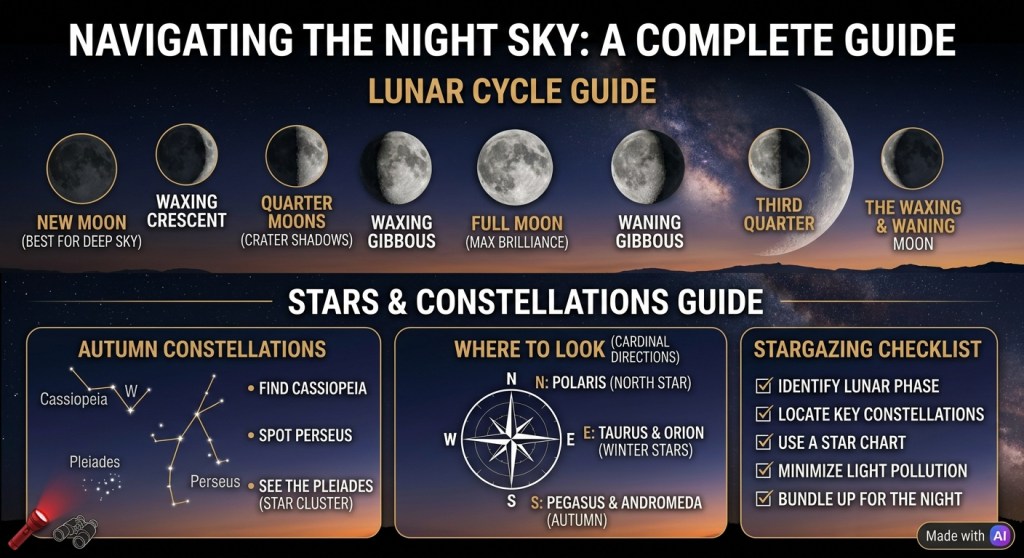
Key Lunar Phases for November 2026
- November 1–2 — Last Quarter Moon: Positioned high overhead near dawn, casting long, stark shadows across prominent craters like Tycho and Clavius.
- November 8–9 — New Moon: The prime dark-sky window of the month! With zero moonlight interfering, faint nebulae, star clusters, and distant galaxies glow at their absolute brightest.
- November 17 — First Quarter Moon: Perfect for early evening family observing sessions. The Moon sits high in the south at sunset, revealing sharp ridge detail along the Mare Imbrium boundary.
- November 24 — The Full Frost Moon: Rising shortly after sunset, the full moon floods late autumn backyards with a brilliant, silvery glow.
Stan’s Stargazing Tip:During the dark-sky week surrounding the New Moon on November 8–9, target faint deep-space objects like the Triangulum Galaxy (M33) or the Pleiades. When observing the dazzling Full Frost Moon later in the month, thread anAstromania 1.25″ Variable Polarizing Filter onto your eyepiece to cut extreme glare and protect your eye comfort.
2. Planetary Roundup: Jupiter, Saturn, and Pre-Dawn Alignment
November brings phenomenal planetary action, highlighted by brilliant evening gas giants and a rare pre-dawn gathering of bright worlds!
Jupiter: The Autumn Showcase
Jupiter is the undisputed king of the November night sky! Rising in the east during the evening and remaining visible through the night, Jupiter shines at its brightest and largest of the season. Through a simple pair of binoculars, you can easily spot its four Galilean moons—Io, Europa, Ganymede, and Callisto—lined up like bright cosmic beads. Higher magnification with a backyard telescope reveals dark Equatorial Belts and the famous Great Red Spot.
- Date: November 15–16, 2026 (closest approach)
Star Walk
- Planets involved: Jupiter and Saturn (with Mars also nearby in the sky)
- Angular separation: ~1°11′ (about three Full Moon diameters)
- Visibility: Pre‑dawn — best from late evening into the hour before sunrise
- Location: Visible from Fort Thomas, KY, and much of the U.S. under dark skies
Astronomy Magazine
- Equipment: Naked eye or binoculars; binoculars improve detail
www.t
Saturn: Evening Ring Showcase
Saturn remains prominently placed high in the southern sky during early evening hours. Its warm golden light offers steady, crisp views. A light bucket telescope easily resolves its magnificent ring system, the dark Cassini Division gap, and its giant moon, Titan, before the planet sets in the late night hours.
Pre-Dawn Parade & Mars-Jupiter Conjunction
For early risers, mid-to-late November presents a dramatic pre-dawn lineup. Around November 15–16, Mars and Jupiter pass extremely close to one another in the sky—close enough to frame together in the same binocular field of view! Meanwhile, dazzling Venus shines as the “Morning Star” low in the east, accompanied by distant Uranus visible in binoculars near Taurus.
3. Stars and Constellations: Taurus, The Pleiades & Perseus
November marks the arrival of classic late-autumn constellations, rich with sparkling star clusters and deep-sky treasures.
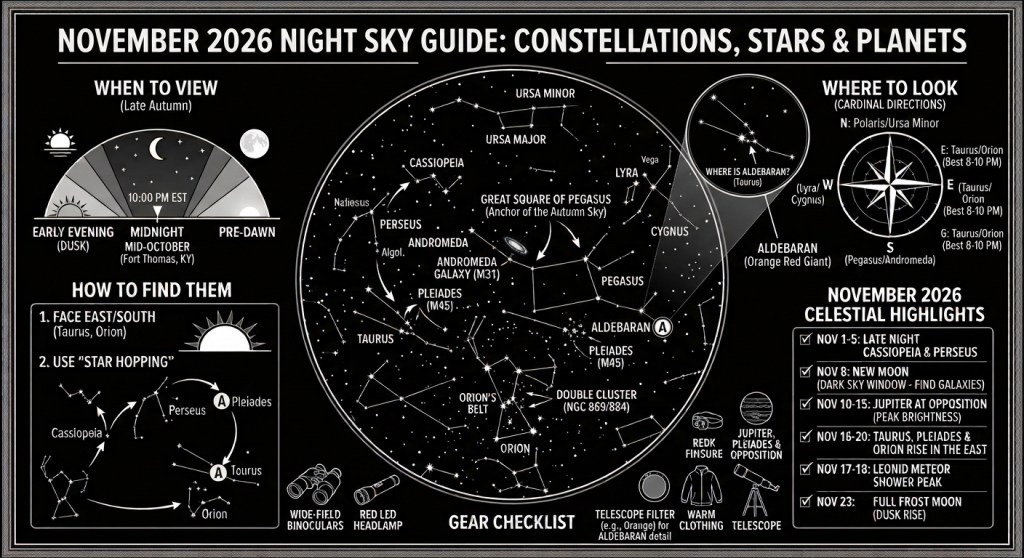
Taurus the Bull & The Pleiades (M45)
Look toward the eastern sky during early evening to locate Taurus. Anchored by the bright orange-red giant star Aldebaran, Taurus represents the bull charging across the sky.
- The Pleiades (The Seven Sisters / M45): Riding on the back of Taurus, this jewel-box open star cluster is one of the most magnificent sights in the sky. Easily visible to the naked eye as a tiny dipper shape of blue-white stars, a simple pair of binoculars reveals dozens of glittering stars suspended like diamonds on dark velvet.
Perseus & The Double Cluster
High overhead, the constellation Perseus guards the autumn sky. Positioned between Perseus and Cassiopeia sits the famous Double Cluster (NGC 869 & NGC 884). These side-by-side star clusters are easily spotted with binoculars or a wide-field eyepiece, showing hundreds of dense, sparkling stars.
4. November Celestial Events: Leonid Meteors & Conjunctions
| Date | Sky Event | Target / Direction | Best Viewing Time |
| Nov 8–9 | New Moon (Dark Sky Window) | Deep Sky (Pleiades, Double Cluster) | All Night |
| Nov 11–12 | Northern Taurid Meteor Peak | Taurus / Full Sky (Fireball Watch) | Midnight to Pre-Dawn |
| Nov 15–16 | Mars & Jupiter Conjunction | Eastern Sky (Very Close Pairing) | Pre-Dawn |
| Nov 17–18 | Leonid Meteor Shower Peak | Eastern Sky (Leo Radiant) | Midnight to Pre-Dawn (Moon-Free!) |
| Nov 24 | Full Frost / Beaver Moon | Eastern Horizon | Dusk / Early Evening |
The Leonid Meteor Shower (Peak: November 17–18)
Produced by debris left behind by Comet Tempel-Tuttle, the Leonid Meteor Shower peaks on the night of November 17 into the morning of November 18. The waxing crescent Moon sets early in the evening, leaving a completely dark, moonless sky for peak viewing hours!
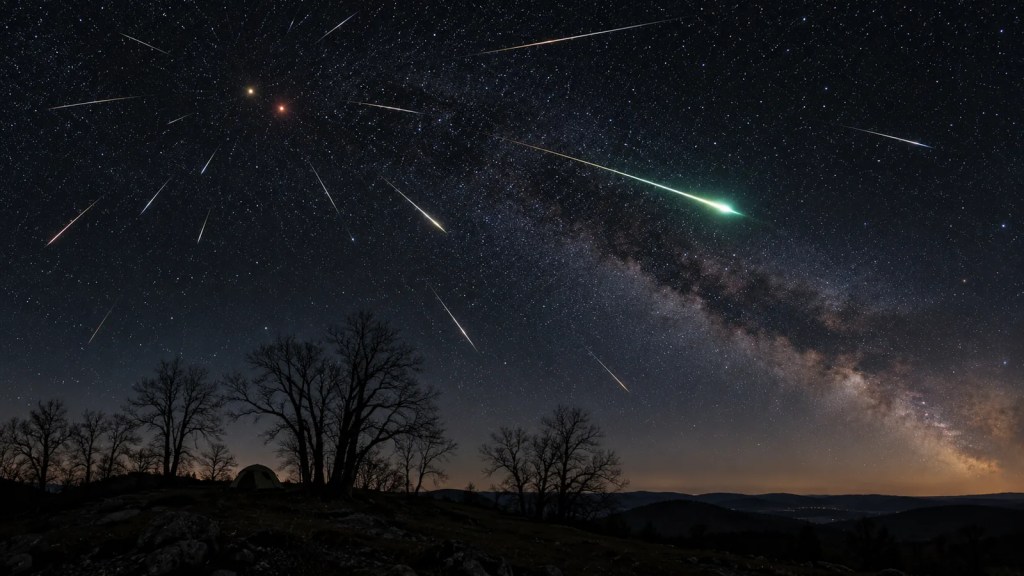
The Leonids are world-famous for being extremely fast—hitting Earth’s atmosphere at 44 miles per second—and frequently leaving glowing, persistent vapor trails! Expect around 10 to 15 meteors per hour under dark skies.
Stan’s Stargazing Tip:You don’t need a telescope or binoculars to watch meteor showers—your bare eyes give you the widest field of view! Recline in a cozy lawn chair facing east toward the constellation Leo after midnight, wrap up in heavy blankets, and give your eyes 20 full minutes to adapt to the dark.
Stargazer’s Gear Toolkit for November
Crisp autumn nights mean cold air and dew, so having the right gear keeps your observing sessions warm and productive:
- Wide-Field Astronomy Binoculars: A sturdy pair of Celestron Cometron 7×50 Binoculars offers a wide field of view, ideal for framing the Pleiades star cluster and sweeping the Milky Way.
- Variable Polarizing Filter: Threading an Astromania 1.25″ Variable Polarizing Filter onto your eyepieces dials down harsh glare when inspecting Jupiter or the bright Full Frost Moon.
- Red LED Headlamp: Keep your dark adaptation intact while reading star charts or adjusting gear with an EverBrite Dual Red/White LED Headlamp.
Beginner & Advanced Observer Guide
For the Absolute Beginner
- Star Hopping 101: Start with bright anchors! Find the “W” shape of Cassiopeia high in the north. Follow the point of the “W” downward to locate Perseus, and then sweep right to land on the sparkling cluster of The Pleiades.
- Understanding “Seeing” Conditions: If the stars are twinkling wildly overhead, Earth’s upper atmosphere is turbulent. High-power views will look blurry. On nights when stars shine steadily without flickering, fire up your higher-magnification eyepieces for crisp details on Jupiter and Saturn!
For the Experienced Astronomer
- Targeting the Triangulum Galaxy (M33): Around the New Moon on November 8–9, challenge yourself to find M33 in the constellation Triangulum. Under dark rural skies, this face-on spiral galaxy shows faint, delicate spiral arm structure in 8-inch and larger light bucket reflectors.
- Jupiter Moons Transits: Check a sky app for precise timing to observe shadow transits, where the dark circular shadows of Io or Europa cross directly over Jupiter’s bright cloud tops.
Quick Reference Checklist for Families
- Dress for Autumn Frost: November temperatures drop rapidly after dark. Layer up with thermal clothing, insulated boots, heavy gloves, and bring a thermos of hot cocoa to keep young astronomers warm.
- Protect Night Vision: Avoid looking at white flashlight beams or bright cell phone screens. Red light keeps your dark adaptation intact so you can spot faint deep-sky targets.
- Manage Dew on Optics: Late-autumn moisture can quickly fog up lenses and eyepieces. Store gear in an unheated garage or porch prior to observing so it matches the outdoor temperature and use dew shields to keep optics dry.
Clear skies and happy hunting!

