How to Reveal the Hidden Universe with Your Smartphone
Have you ever looked up at the night sky from your backyard and felt like you were looking at a giant, empty black blanket with just a few tiny holes poked in it? On most nights, especially if you live near a city, you might see the moon, a couple of bright planets, and the famous stars that make up the Big Dipper. But to the human eye, the space between those stars looks like a vast, lonely void.
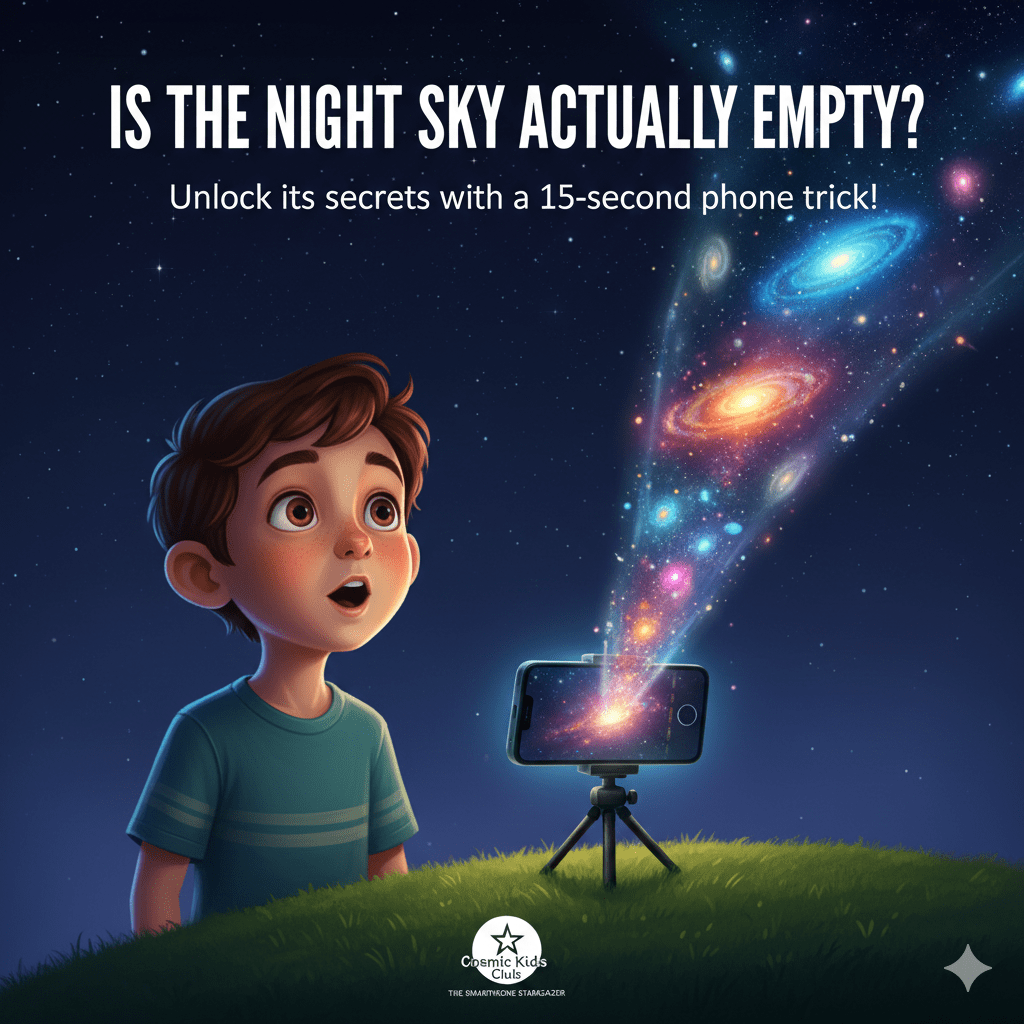
Well, I have a secret for you: The sky is not empty.
Right now, directly above your head, the sky is crowded with millions of stars, swirling clouds of colorful gas called nebulae, and entire “island universes” known as galaxies. They are there every single night. The only reason you can’t see them is that your eyes aren’t designed to “catch” enough light.
Today, we are going to turn your family’s smartphone into a scientific instrument called a Light Bucket. With just 15 seconds of patience, you are going to photograph things that have been invisible to humans for thousands of years.
The Science: Why Your Eyes are “Fast” but “Weak”
To understand how we’re going to see the invisible, we first have to understand how our eyes work. Your eyes are like incredible, high-speed video cameras. They take about 30 “pictures” every single second and send them to your brain. This is why, when a friend throws a baseball at you, you can see it moving through the air and catch it.
However, there is a downside to being that fast. Because your eye “resets” so quickly, it only has a tiny fraction of a moment to catch the light from a star. If that star is very far away, your eye just doesn’t have enough time to collect the photons (light particles) before it resets for the next picture.
The Light Bucket Analogy
Imagine it is raining outside very lightly. If you hold out a tiny thimble for just one second, you might not catch a single drop. But if you put a big bucket on the lawn and leave it there for 15 seconds, you’ll find that the bucket has collected enough water to fill a whole glass.
A smartphone camera can act exactly like that bucket. We can tell the camera to keep that shutter open for 15 full seconds. During those 15 seconds, the camera sensor sits perfectly still, catching every single tiny “drop” of starlight that falls into it.
Mission Gear: What You’ll Need
The best part about modern astronomy is that you don’t need a $2,000 telescope to get started. However, to be successful, you do need a few pieces of specialized astronomy equipment to keep your camera steady.
- A Smartphone: Almost any smartphone made in the last few years has a “Night Mode” or “Pro Mode.”
- A Tripod (The Most Important Part): Remember the bucket analogy? If you wiggle the bucket, you’ll spill the “light.” If the phone moves even a tiny bit, the stars will look like messy squiggles. You can find sturdy, affordable tripods and phone mounts here: Best Astronomy Tripods & Gear.
- A Dark Spot: Find a spot in your yard away from streetlights.
- A Red Flashlight: White light “shrinks” your pupils. Astronomers use red light to see their gear while keeping their eyes adjusted to the dark. You can find red-light headlamps and flashlights in this Astronomy Equipment Collection.
The 15-Second Challenge: Step-by-Step
Step 1: Find an “Empty” Patch
Point your tripod-mounted phone at a part of the sky that looks the darkest.
Step 2: Configure Your “Bucket”
- On an iPhone: Tap the arrow at the top, select the “Yellow Moon” icon (Night Mode), and slide it to Max.
- On an Android: Go to “More” > “Pro” > “S” (Shutter Speed) and set it to 15s.
Step 3: Use the Self-Timer
To prevent the phone from shaking when you touch it, set your phone’s Self-Timer to 3 seconds. Tap the button, step back, and let the camera do its magic!
Step 4: The Reveal
When the timer finishes, look at your gallery. You will see a “Sea of Stars” that weren’t there before!
What are You Learning?
When you look at your photo, you are looking at real scientific data!
- Star Population: Count the stars in your photo vs. what you can see with your eyes.
- Star Colors: Notice the colors! Blue stars are very hot (10,000°C+), while Red/Orange stars are “cooler” (3,000°C).
- Light Pollution: If your photo looks orange, you’re seeing “Skyglow” from city lights.
If this experiment makes you want to see even deeper into space, you might consider moving up to a pair of stargazing binoculars or a beginner telescope. You can browse high-quality options here: Explore Beginner Astronomy Equipment.
Next Month’s Mission…
Now that you’ve mastered the “Light Bucket” technique, you’re ready for a bigger challenge. Next month, we are going to hunt for the Andromeda Galaxy—the furthest thing the human eye can see!
Clear Skies, Stargazers!
📚 References & Scientific Footnotes
- Light Integration: NASA – Telescope Basics
- Stellar Classification: American Museum of Natural History
- Light Pollution: International Dark-Sky Association
 Stan's Hobbies and Interests