The Ultimate Guide to Model Train Scales: Finding the Right Fit for Your Family Layout

Stepping into the world of model railroading is an exciting journey full of creativity, engineering, and family fun. However, when you first walk into a hobby shop or browse online stores, one of the first terms you’ll encounter is “scale.”

Simply put, scale refers to the proportion of a model train relative to its real-world prototype (often called “prototype scale” or 1:1). Choosing the right scale is the single most important decision you will make when starting out, as it dictates how much space you need, how easy the trains are to handle, and what products are available.

Whether you have a spare bedroom, a small shelf, or a sprawling basement, this comprehensive 2026 beginner’s guide breaks down the world’s most popular model train scales—their sizes, pros, cons, and space requirements—so you can pick the perfect scale for your home!

Model Train Scales at a Glance

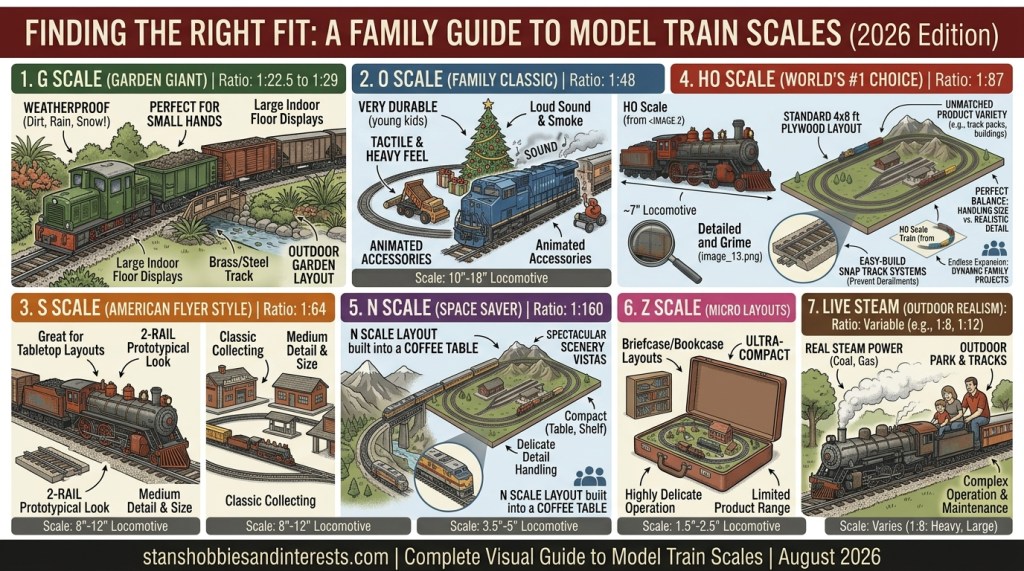
Scale NameRatio / ProportionTypical Size (Locomotive Length)Best Space RequirementIdeal Operator Age
G Scale1:22.5 to 1:2918 – 24+ inchesLarge basements or outdoor gardensAll ages (Great for small hands)
O Scale1:4810 – 16 inchesLiving room floor / Large spare roomAges 5 to adults
S Scale1:648 – 12 inchesMedium spare roomGeneral hobbyists
HO Scale1:87 (World’s #1)6 – 10 inches4×8 ft table / Small roomAges 8 to adults
N Scale1:1603.5 – 5 inchesCoffee table / Compact shelf / DeskAges 10 to adults
Z Scale1:2201.5 – 2.5 inchesBriefcase / Bookcase shelfOlder teens and adults

1. HO Scale (1:87 Ratio) — The World’s Most Popular Choice

HO Scale stands for “Half O” because it is roughly half the size of traditional O scale trains. Representing a 1:87 ratio, HO scale is the undisputed heavyweight champion of the model railroading world, making up over 60% of the entire hobby market.
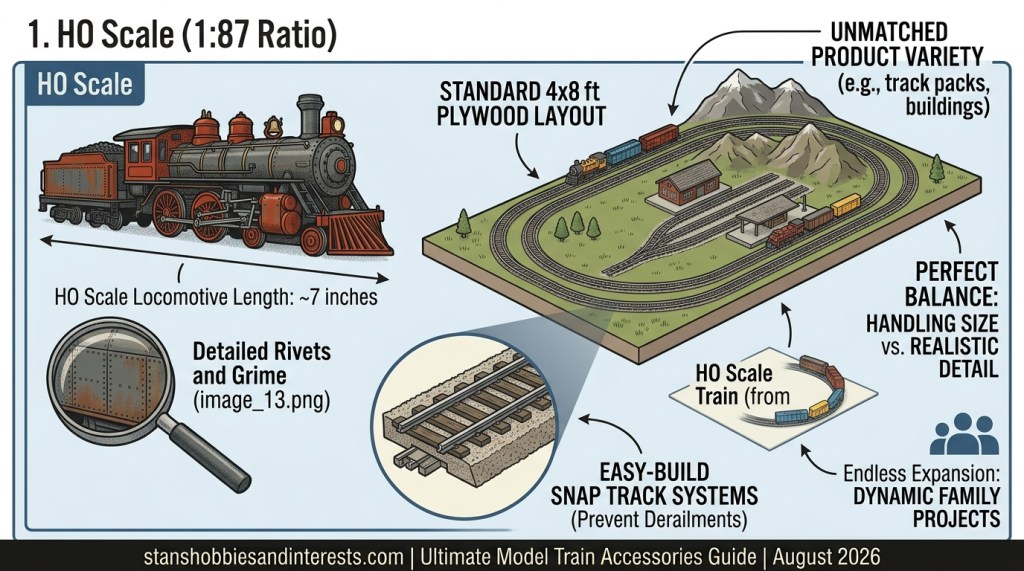
   
  • Size: A standard diesel or steam locomotive is roughly 6 to 9 inches long.
  • Space Needed: A standard 4×8 foot sheet of plywood provides ample space for a complete oval layout with sidings, freight yards, and detailed scenery.
  • Product Availability: Unmatched. Virtually every railroad line, building kit, freight car, track variation, and digital sound accessory ever created is available in HO scale.
  • Pros:
    • Perfect balance of handling size and detail.
    • Huge selection of budget-friendly starter sets and advanced digital equipment.
    • Easy to assemble track systems with built-in roadbeds (like Bachmann E-Z Track or Kato Unitrack).
  • Cons:
    • Requires a dedicated table or board space (harder to fit on narrow bookshelves).
  • Best For: Families with children ages 8 and up who want a balance between high detail, affordable starter options, and endless expansion potential.

2. N Scale (1:160 Ratio) — The Compact Space Saver
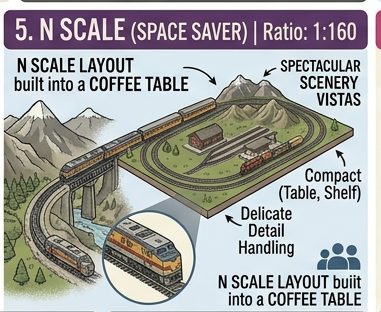
At nearly half the size of HO scale, N Scale (1:160 proportion) allows modelers to build sweeping landscapes and long, realistic trains in very tight spaces.

  • Size: A locomotive is roughly 3.5 to 4.5 inches long—about the size of a finger.
  • Space Needed: A complete layout with loop tracks, switching yards, and mountains can fit on a 2×4 foot hollow-core door, a coffee table, or a narrow wall shelf.
  • Product Availability: Very strong and growing rapidly. Modern manufacturing allows N scale locomotives to feature incredible detail and working digital sound decoders.
  • Pros:
    • You can run long freight trains without taking over a room.
    • Excellent for urban apartments or homes with limited extra space.
    • Scenery dominates the layout, creating breathtaking mountain and landscape vistas.
  • Cons:
    • Tiny wheels and delicate detail parts require patient handling and good eyesight.
    • Re-railing cars on track can be challenging for young children.
  • Best For: Older kids (10+), teens, and adults who love scenery or have limited indoor space.

3. O Scale / O-Gauge (1:48 Ratio) — The Heavyweight Family Classic
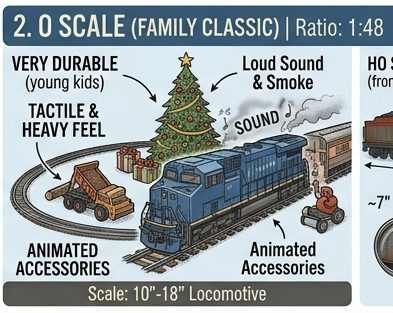
When people think of classic Christmas train sets around the holiday tree, they are usually thinking of O Scale (1:48 proportion), popularized by brands like Lionel. O scale trains are large, heavy, and extremely tactile.

  • Size: Locomotives range from 10 to 18 inches long and feel substantial in hand.
  • Space Needed: Requires significant room. A basic track circle usually needs at least a 4×4 foot footprint, while a multi-train layout often requires a large basement or full spare room.
  • Product Availability: Excellent, especially for ready-to-run sets, animated accessories (like operating log loaders and flashing crossing gates), and classic American railroad names.
  • Pros:
    • Nearly indestructible; perfect for younger children to handle without breaking fine parts.
    • Great built-in action features, smoke generators, and loud, realistic sound systems.
    • Easy to place on tracks without frustration.
  • Cons:
    • Trains and tracks are significantly more expensive than HO or N scale.
    • Track takes up a large footprint on floors or tables.
  • Best For: Families with young children (ages 5–8), holiday floor displays, and lovers of classic 20th-century toy trains.

4. G Scale (1:22.5 to 1:29 Ratio) — The Garden & Living Room Giant
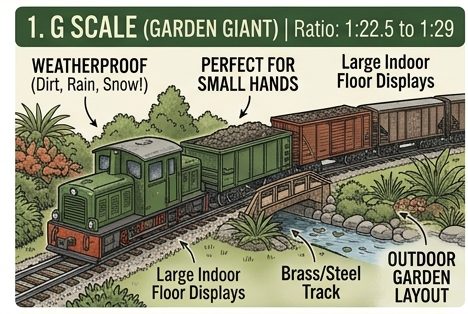
G Scale (short for “Garden Scale”) is the giant of the model train world. Built from weather-resistant plastics and heavy brass or stainless steel rails, these trains are designed to operate both indoors and outdoors in real gardens!

  • Size: Locomotives are 18 to 24+ inches long and weigh several pounds.
  • Space Needed: Ideal for outdoor backyards, large patios, or surrounding the floor of a spacious living room.
  • Product Availability: Good, with major brands like LGB, Bachmann, and USA Trains specializing in rugged garden locomotives, outdoor track, and durable rolling stock.
  • Pros:
    • Weatherproof: Can run through outdoor garden beds, dirt, rain, and snow!
    • Extremely durable and easy for toddlers and grandparents alike to operate.
    • Makes an incredible visual centerpiece for landscaping or holiday displays.
  • Cons:
    • Requires a large financial investment per locomotive and track section.
    • Bulky to store indoors when not in use.
  • Best For: Outdoor landscaping enthusiasts, backyard hobbyists, and family floor displays.

5. Z Scale (1:220) & S Scale (1:64) — Niche & Specialty Sizes
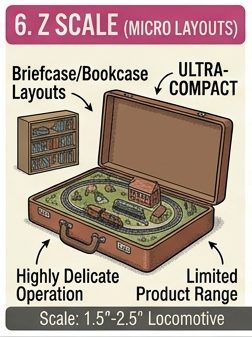
  • Z Scale (1:220): One of the smallest micro-scales in existence. Locomotives are barely 2 inches long! You can build a complete operating Z scale railroad inside a briefcase or a picture frame. However, parts are delicate and selection is limited compared to HO or N.
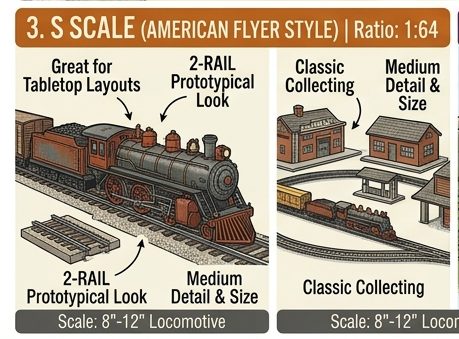
  • S Scale (1:64): Famous for American Flyer trains, S scale sits directly between O and HO scale. It offers a great tactile feel with classic 2-rail track, though product variety is smaller and mostly catered to specialized collectors.
How to Choose the Right Scale: A Quick Decision Checklist

To narrow down your choice, answer these three quick questions:

  1. How much space do you have available?
    • Shelf or small corner: N Scale
    • 4×8 Foot Table or Spare Room: HO Scale
    • Large Floor / Basement: O Scale
    • Backyard / Garden: G Scale
  2. Who will be operating the trains?
    • Young children (Ages 3–7): O Scale or G Scale (durable and easy to place on rails).
    • School-age kids & Parents (Ages 8+): HO Scale (the ultimate family compromise).
    • Teens & Detail Builders: HO Scale or N Scale.
  3. What is your budget and product goal?
    • If you want the widest variety of track, building kits, cars, and budget options, stick with HO Scale.

Final Thoughts: Finding Your Family’s Perfect Scale

There is no single “best” scale in model railroading—only the scale that best fits your family’s space, budget, and imagination. Whether you choose the compact efficiency of N scale, the unmatched variety of HO scale, or the grand presence of O gauge, building a model railroad creates a hands-on learning environment and lasting memories for years to come.

Until then, happy modeling, and keep those trains rolling!

Five Starter Track Plans That Make Model Railroading Fun.


Stepping into the world of model trains is exhilarating—especially if a shiny new starter set found its way under the tree this holiday season! While simply running loops is good fun, adding a layout designed for operational challenges opens up new levels of enjoyment and learning. Below, you’ll find five proven, easy-to-build layouts ideal for new modelers. Each plan encourages hands-on activity and sets you up for deeper adventures in the world’s greatest hobby.


1. The Classic Oval with a Siding

Why it’s great for beginners:
Every starter set includes enough track for a simple oval. The continuous closed loop lets you just run trains and watch them go. Once the thrill of spinning laps wanes, it’s time to add a short siding. Using a turnout, you can branch off for storage, pretend deliveries, or engine changes.

How to make it interesting:

  • Use your siding as a delivery spot for different freight cars.
  • Invent stories: “Drop the boxcar at the bakery, pick up the flatcar at the lumber mill.”
  • Challenge yourself with basic operations, such as swapping cars between trains using the siding to minimize moves.

Scalability:
This layout is endlessly expandable. Add sidings and industries as your collection grows, turning a simple loop into a busy rail network.More Info.


2. Inglenook Sidings – The Puzzle Champion

Why it’s great for new modelers:
This classic British yard puzzle fits on a bookshelf and works in HO, N, or OO scale—especially if space is limited. The basic ingredients are a headshunt (main track) and three sidings: one long, two short.

How to play the Inglenook puzzle:

  • Arrange 8 cars in the sidings.
  • Draw cards to assemble a train of 5 cars in a set order.
  • Only use the available track space—no cheating!
    The fun comes from working out how to marshal the train by shunting back and forth, often with limited room to maneuver.

Learning from it:
The Inglenook teaches essential switching skills, logical thinking, and real-world railroading practices like coupling, reversing, and making strategic decisions. It’s endlessly replayable, and you can compete against friends or your own “best score.”
For detailed building tips, see resources like the [Wymann sidings guide].More Info.


3. The Timesaver – A Tidy Little Challenge

Why it’s great:
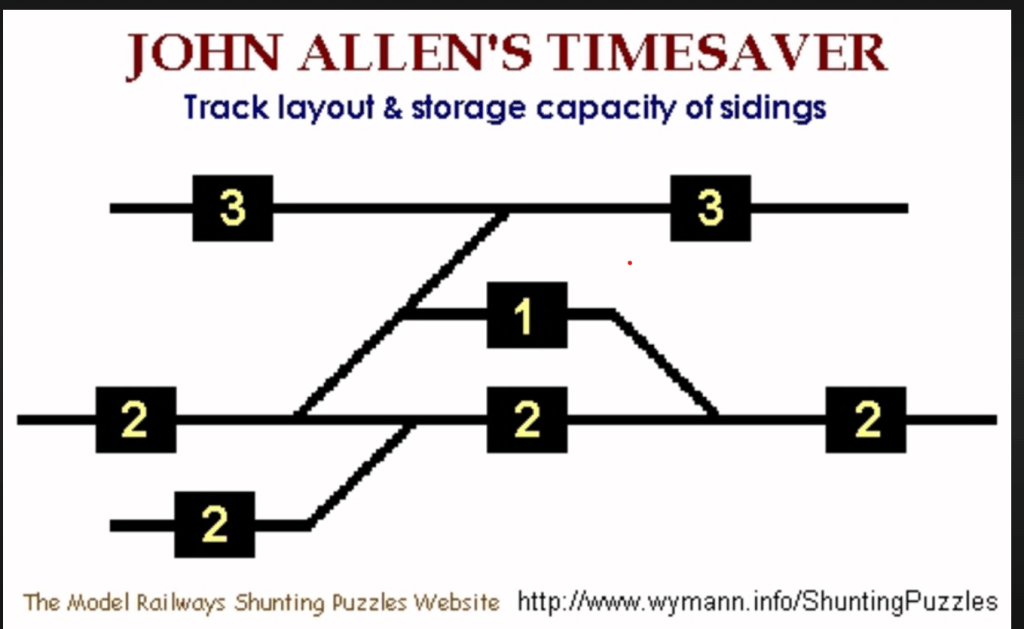
Invented by John Allen, the Timesaver is a classic switching puzzle famous worldwide for its tricky operations. It uses a simple yard ladder with five stub sidings and a connecting main line.

How to set up:

  • Place a car in each siding, randomly.
  • Assign each car a destination: warehouse, station, mill, etc.
  • Your goal is to sort the cars to those destinations using as few moves as possible.

Why you’ll love it:
Timesaver fits on a door-sized table or smaller and can be customized with extra spurs, scenery, or industries. It brings real railroad logic to the living room, keeps you thinking, and becomes even more fun when played as a timed challenge or shared with friends.More Info.


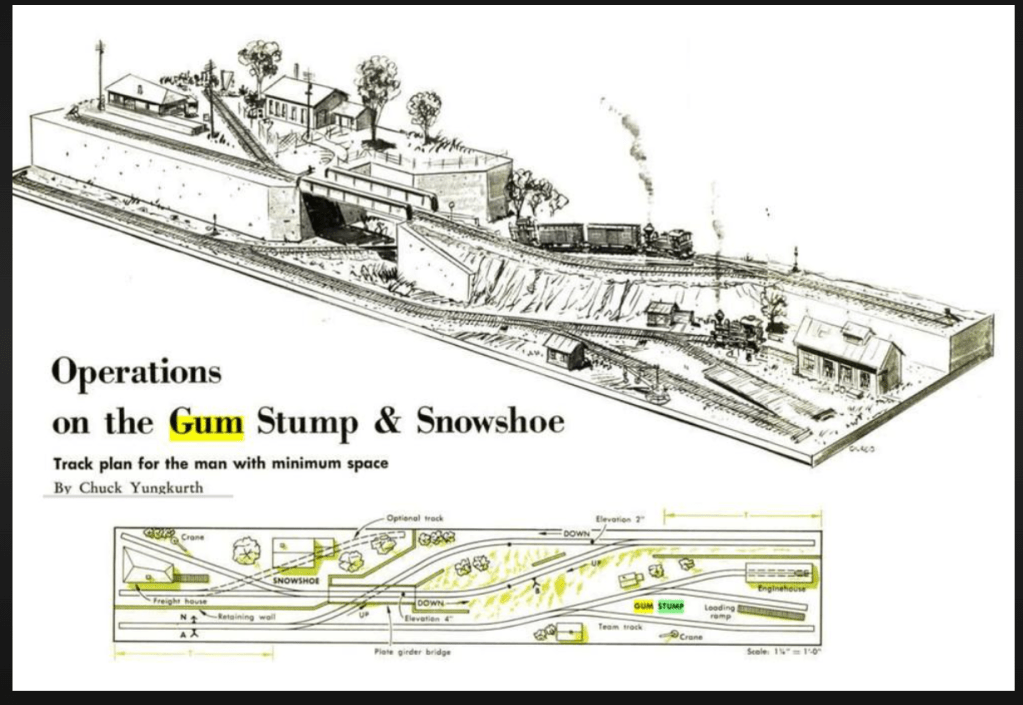
4. Point-to-Point Branch Line

Why it’s great for play and realism:
Not all trains run in endless circles! Many real railroads operate “branches” linking small towns or factories in a straight (or gently curved) line. A point-to-point layout brings purpose and realism to your runs.

How to use it:

  • Build a straight or L-shaped track with a station at either end and optional sidings for industry.
  • Send your train from one end to the other, making “collections” and “deliveries” along the journey.
  • Use waybills or dice rolls to assign tasks: “Deliver the blue boxcar to the furniture factory, then pick up the coal hopper.”

Benefits for beginners:
The branch line approach teaches scheduling, multi-tasking, and has a much more realistic feel than pure loops or ovals. Best of all, it can fit on a bookshelf or desktop and you can expand it by adding stations or yards over time.More Info.

For Model Railroad Supplies look Here.


5. Holiday Village Layout – Family, Fun, and Festivity

Why it’s a perennial favorite:
Trains and Christmas go together perfectly! Building a simple loop around the tree, through a festive village, offers unlimited imaginative play and family tradition.

How to set up:

  • Lay a continuous loop around your tree or under the living room table.
  • Add short sidings and decorate with miniature buildings, people, and seasonal scenery (fake snow, street lamps, even Santa!).
  • Play delivery games: “Drop presents at the post office,” “Pick up candy from the sweet shop,” etc.

Making memories:
This layout isn’t just for rail fans—it’s for everyone! Kids can get hands-on, grownups can compete in delivery races, and every year, you can add new accessories or rolling stock.More Info.


Tips for Starting Strong with Your First Layout

Stay Simple:
Don’t stress about complex wiring or scenery for your first build. Focus on reliable track-laying, smooth running, and fun operations.

Adapt to Your Space:
From tabletops to under-the-tree villages, these track plans work in small spaces and can be moved or modified as needed.

Build Gradually:
Start with the basics, then add turnouts, sidings, and mini-scenes as your skills grow and your interest deepens. Every new piece brings new challenges and fun.

Embrace the Community:
Model railroading is filled with welcoming enthusiasts who love helping beginners. Join a local club, watch YouTube build-alongs, or follow forums to ask questions and get inspired.More Info.


Conclusion: The Start of a Wonderful Journey

No matter which starter set you received or which track plan you choose, remember: every layout is a blank canvas for creativity, learning, and play. These five layouts are practical, accessible, and designed to teach you the joys of operations—a lifelong model railroad adventure awaits!

Whether you chase holiday magic, puzzle out switching challenges, or simply enjoy the whir and click of wheels on rails, you’re now part of a worldwide tradition. So set up your tracks, gather loved ones, and let imagination lead the way—steam ahead into model railroading fun!


Happy Railroading!
For more inspiration and detailed beginner guides, explore resources at Trains.com and join local groups or online communities to boost your skills and enthusiasm.More Info

  1. https://www.trains.com/mrr/beginners/model-railroading-the-beginners-guide/
  2. https://www.trains.com/mrr/beginners/10-recommended-track-plans-for-beginners/
  3. https://www.reddit.com/r/modeltrains/comments/1uuxfb/complete_beginner_wondering_where_to_start_on_a/
  4. http://www.wymann.info/ShuntingPuzzles/SPL-build.html
  5. https://www.reddit.com/r/modeltrains/comments/zm1o0k/jd_railroad_ho_scale_christmas_train_layout/
  6. https://shop.trains.com/blogs/the-trains-com-store-blog/crafting-your-christmas-model-train-layout
  7. https://www.hearnshobbies.com/blogs/model-kits/what-is-the-most-expensive-model-railway-layout-the-cheapest-which-layout-should-you-go-for
  8. https://www.reddit.com/r/modeltrains/comments/wxi987/looking_to_get_started_with_my_first_model_train/
  9. https://www.armballast.com/best-starter-set-for-model-railroading/
  10. https://forum.mrhmag.com/post/good-starter-sets-for-newbie-12192816
  11. https://www.trainshop.co.uk/blog/post/1400-shunting-yards-designing-a-track-plan-for-realistic-operations.html
  12. https://www.youtube.com/watch?v=GHLMFrk9zXY
  13. https://www.youtube.com/watch?v=Ozo7gK4oc6Y
  14. https://www.nmra.org/beginners-guide-part-9-operations
  15. https://www.trainworld.com/train-set/ho-scale-train-set.html
  16. https://www.youtube.com/watch?v=le6MmX7wZHU
  17. https://www.reddit.com/r/modeltrains/comments/qfp2no/recommendations_needed_christmas_village_meets/
  18. https://www.youtube.com/watch?v=cUcVJM5bsSw
  19. https://www.modeltrainforum.com/threads/designing-for-operations.198257/
  20. https://www.trainz.com

Switching Made Simple: Model Railroad Operations Through Puzzles

Here is a follow-up article focused on model railroading, designed to teach switching operations through interactive puzzles. The article introduces you to operational concepts, explains how puzzle-based exercises build skills, and provides instructions for accessing the online puzzle series, which progresses from beginner-friendly to advanced.conrail1285+3


Switching operations are the heart of both real-world railroads and engaging model layouts. Whether you’re simulating a busy freight yard or managing branchline deliveries, understanding the basics of car movements is what transforms toy trains into an operational railroad. In this article, you’ll explore switching concepts through a series of carefully designed puzzles—each one created to challenge, educate, and entertain railfans of all ages.trains+1

Why Switching Matters

Switching (also called shunting) is the process of sorting, assembling, and delivering railcars to their destinations. In real railroad operations, switch crews must plan every move, navigate limited track space, and problem-solve to efficiently route cars. On your model railway, switching operations add realistic purpose to running trains, making every operating session more meaningful and rewarding.nmra+2

Learning By Doing: Puzzle Format

This hands-on puzzle series was created to demystify the basics of switching. Each challenge provides a layout schematic and a set of objectives. Starting with the fundamentals—simple moves, basic sidings, and runaround tracks—you’ll build your expertise, session by session. The puzzles gradually increase in complexity, introducing new strategies and operational scenarios.nmra-scwd+1

How To Join In

All puzzle materials and instructions are hosted online. Access the puzzles here: YOUR PUZZLE WEBSITE LINK HERE.

  • Beginner Puzzles: Learn basic maneuvers like the pull, shove, and runaround.trains
  • Intermediate Puzzles: Tackle car sorting, limited track scenarios, and industry switching.
  • Advanced Operations: Practice building trains to spec, working with switch lists, and navigating complex yards.

Each puzzle includes diagrams, clear rules, and introductory notes. Work through them at your own pace; as your confidence grows, the next level will introduce new twists.

Family-Friendly Challenges

Model railroading is truly a family affair. Puzzles are designed for all ages—kids can start with basic moves, while adults and teens attempt trickier switching problems. Collaborate as a crew: assign one person as the engineer, another as conductor, and let everyone try their hand at solving each session’s “mission”.hearnshobbies+2

Step-by-Step Success

Switching puzzles mirror real railroad procedures. A typical job may ask you to:

  • Move boxcars to specified industries
  • Pickup and reassemble cars in order
  • Use runaround tracks to navigate trick sidings
  • Manage space, avoid fouling other tracks, and update your switch listrrmodelcraftsman+1

Hints and explanations guide beginners at each step. As you work through the series, you’ll discover pro tips for efficiency and precision—skills that transfer back to your full layout operations.wymann+1

Growing Your Skills

Each puzzle in the series builds on prior lessons. You may start with straightforward pulls and shoves, but soon you’ll face limited switch leads, multi-car movements, and service schedules. The skills you gain—planning, teamwork, and problem-solving—will make operating your model railroad even more enjoyable.conrail1285+2

Ready to Switch?

Visit the puzzle website, choose your starting level, and dive into the challenges. Each puzzle is open-ended: try multiple strategies, collaborate with friends or family, and compare solutions online. New puzzles will be added over time, so keep checking back for fresh operational adventures.

Final Thoughts

Model railroad switching turns play into purposeful operating. These puzzles are more than games—they’re training tools for making model railroading realistic and fun. Whether you’re just starting out or striving for advanced operations, puzzle-based exercises are the perfect way to master the art of switching.

Begin your journey today, and see how a few clever moves can transform your railroad into a bustling, operational railway—one puzzle at a time.nmra-scwd+3


  1. https://conrail1285.com/an-introduction-to-model-railroad-ops/
  2. https://www.nmra-scwd.org/ops-puzzles.html
  3. https://www.trains.com/mrr/beginners/ask-trains/switching-a-model-railroad/
  4. http://www.wymann.info/ShuntingPuzzles/shunting-puzzles.html
  5. https://www.nmra.org/beginners-guide-part-9-operations
  6. https://www.hearnshobbies.com/blogs/model-railways/model-railroading-for-families-creating-memories-on-miniature-tracks
  7. https://www.philobiblon.com/eisenbahn/puzzle_article.shtml
  8. https://rrmodelcraftsman.com/set-up-your-layout-for-realistic-operations/
  9. https://midwestmodelrr.com/blog/understanding-model-railroad-operations-a-journey-into-the-fascinating-world-of-model-railroads/
  10. https://www.youtube.com/watch?v=3OHnVh4sEPU
  11. https://www.youtube.com/watch?v=wxZUIhMjjIA
  12. https://www.youtube.com/watch?v=7LdHlfPOB6o
  13. https://www.trains.com/mrr/how-to/how-to-switch-model-railroad-freight-cars/
  14. https://shop.trains.com/collections/puzzles-games
  15. http://www.wymann.info/ShuntingPuzzles/
  16. https://shop.trains.com/products/railroad-family-trees-puzzle
  17. https://www.wired.com/2007/04/my-son-age-3-is/
  18. https://www.delmarvamodelrailroadclub.org/Operations/Operations.html
  19. https://www.youtube.com/watch?v=nf0Iz36PGmA
  20. https://www.youtube.com/watch?v=ldl0VoMgQCs