Is your locomotive collection starting to resemble a stuttering, stalling mess? As the weather cools and model railroaders head back to their layouts, this is a frustratingly common issue. The immediate, knee-jerk reaction is often to grab whatever solvent is sitting in the garage or workshop to scrub the rails.
However, according to Fran of the Five Minute Modeler, many popular recommendations floating around forums and social media are not only wrong—they actually make the problem worse over time. In a recent segment, Fran took a science-based approach to busting these track cleaning myths so you can spend less time cleaning and more time running trains.
Chapter 1: The Science of Rail Grime (Why Alcohol Isn’t the Answer)
That dark, stubborn grime that builds up on your rails isn’t just room dust. It is, in fact, heavy oxidation caused by micro-arcing between your locomotive wheels and the track as electric current passes through.
Fran highlights a groundbreaking series of articles from Model Railroad Hobbyist magazine that analyzed the chemistry behind rail cleaning. The key takeaway comes down to molecular polarity:
- Polar Solvents (The Problem): Cleaners like isopropyl alcohol (even 91% pure), acetone, and vinegar are polar solvents. While they work immediately to strip off existing dirt, they leave behind a micro-thin film that actively promotes atmospheric moisture attraction. This moisture actually accelerates micro-arcing and rapid oxidation, meaning your track gets dirtier faster.
- Non-Polar Solvents (The Solution): Non-polar solvents strip the gunk without leaving behind an electrically attractive surface. This leaves an electrically stable finish that actively inhibits future micro-arcing.
Based on the MRH research, Fran highlighted top-performing non-polar options:
- Deluxe Materials Track Magic: A product purposely made for model trains.
- Odorless Mineral Spirits: An excellent, inexpensive choice.
- Graphite: Applied in an ultra-thin physical layer.
Chapter 2: Solvents to Avoid
To ensure the long-term health of your track, you should strictly avoid the following:
- The Polar Cleaners: As mentioned above, stay away from isopropyl alcohol, acetone, lacquer thinner, vinegar, and ammonia. They work in the short term but accelerate dirt accumulation the following month, creating a maintenance nightmare.
- Goof Off: While it is a non-polar solvent and strips dirt well, it is problematic because it leaves behind a non-conductive, oily residue that turns into an insulator on the railhead.
- Hazardous Fluids: Never use gasoline, kerosene, or turpentine indoors. These are dangerous due to obvious indoor safety and flammability reasons.
Fran’s Go-To Choice: For over 10 years, the presenter’s preferred method has been odorless mineral spirits. It is cheap, readily available, and has far lower fumes than standard mineral spirits.
Chapter 3: The Effective Cleaning Technique
The technique is just as important as the solvent. Fran advises against using abrasive track erasers for routine cleaning, as they leave microscopic scratches that collect dirt faster.
Instead, here is a quick and safe cleaning method demonstrated on the Five Minute Modeler:
- Create the Tool: Take a strip of cotton t-shirt material, wrap it around the end of a long, thin wood strip (like a paint stirrer or a piece of hobby wood), and secure it tightly with tape.
- Apply Solvent: Dip the cloth end into a small dish of odorless mineral spirits.
- Clean: Glide the stick back and forth along the railheads.
Why this method works:
Using this wooden extension keeps your hands far away from delicate scenic details, overhead wires, and telephone poles. It also makes reaching into hidden staging yards or deep tunnels effortless. Be sure to swap out the rag on your stick as soon as it pulls up that thick black streak of grime.
Chapter 4: Preventing Future Oxidation
Cleaning is only half the battle. Once the rails are clean, you want to prevent future oxidation from forming.
Fran treats rails with an electric contact cleaner called No-Ox-ID. A tiny tub supplied by a friend years ago is expected to last a lifetime.
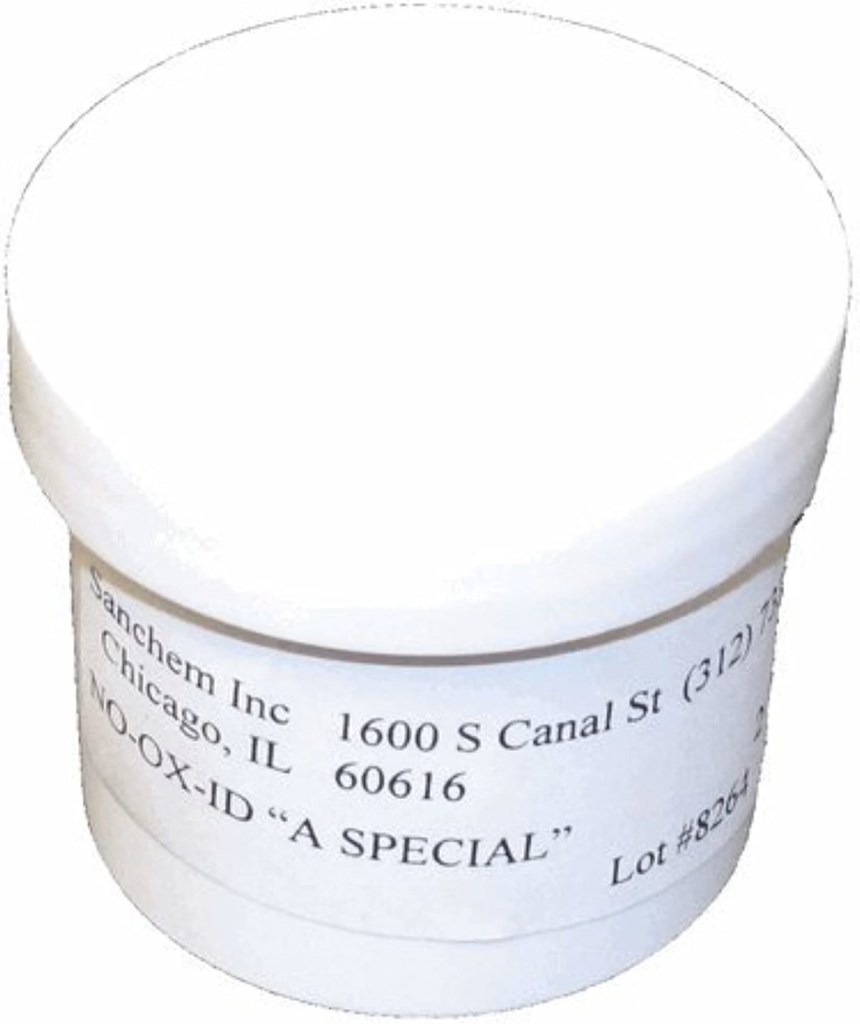
The Application Method:
- Put an extremely tiny dab on the railhead every 10 to 15 feet. Do not glob it on; a microscopic bit goes a long way.
- Then, run a locomotive or a heavy weighted car across the layout to spread that microscopic layer evenly down the track.
By combining a non-polar solvent for cleaning with a light conductive treatment for prevention, Fran reports going two to three years at a time without needing to deep clean mainlines.
Special thanks to Fran at the FiveMinute Modeler for sharing this science-based approach to model railroad maintenance.
Happy modeling!

