Shooting Stars

If you are a serious astronomy fanatic like a lot of us are, you can probably remember that one event in childhood that started you along this exciting hobby. It might have been that first time you looked through a telescope. But for many of us, it was that first time we saw a rain of fire from the sky that we eventually came to know as a meteoroid shower.

A view of a Meteor Shower and the Milky Way with a pine trees forest silhouette in the foreground. Night sky nature summer landscape. Perseid Meteor Shower observation.

At the time when you see the first one, it’s easy to remember the movie “war of the worlds” or some other fantastic image of aliens entering our atmosphere in droves to take over the planet. But with some guidance and explanation of what was going on, we eventually learned that these showers were not at all threatening or any kind of invasion. For the most part meteoroid showers are harmless, part of nature and very fun to watch.

So what are these strange lights in the sky? Are they aliens invading from Mars? Are the comets coming to start the next ice age? Or perhaps asteroids burning up as they enter the earths atmosphere. The answer to the above questions is no to the first and “yes and no” to the other two.

A meteoroid is actually a small piece of space rubble, usually dust or small rocks that come from either a comet or the break up of an asteroid in space and that eventually plummets toward the earth. We say “toward the earth” because the lights you see are the friction of the atmosphere burning up those small space tidbits and creating a spectacular show for all of us as they do so. A particularly exciting moment to witness is when a meteoroid breaks up or explodes on entry. A meteoroid that explodes is called bolides.

There are some interesting details about the life of a meteoroid that make the viewing of shooting stars even more fun. To be seen, a meteoroid only needs to weigh as little as a millionth of a gram. But the thing that makes them so spectacular to see is the tremendous speeds they reach as they enter the atmosphere. Before burning up, a meteoroid will reach between 11 and 74 kilometers per second which is 100 times faster than a speeding bullet.

We tend to think of seeing a shooting star as a freak event and we associate it with superstition (hence, wish on a lucky star). But there are actually thousands of them every year so it really isn’t that rare to see one. In fact, scientists tell us that over 200,000 tons of space matter enters the atmosphere each year and burns up on entry.

Comets are a big source of meteoroids because of the nature of those long tails. A large amount of dust, ice and other space debris gets caught up in a comet’s tail as it moves toward the sun. Then as the comet moves away from the sun in its orbit, tons of this matter is thrown off into space to disperse. As the Earth moves in its routine orbit around the sun, it often crosses through clouds of this discarded matter which becomes one of those “meteor showers” that are so popular for viewing.

These showers of shooting stars are pretty easy for astronomers to predict so you can get into position to see the excitement at just the right time of night and be looking at the right area of the night sky. Usually the astronomy magazine or site will give you a general time and location to be ready to look when the meteoroids start to fall.
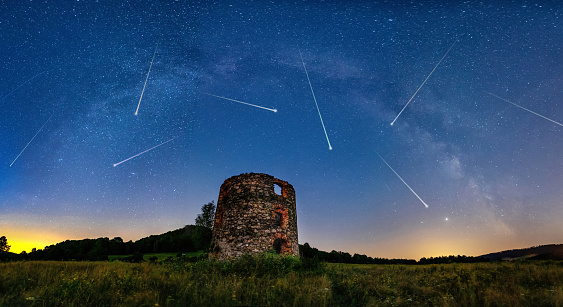
Meteor Shower and the Milky Way with old ruin on foreground

Now keep in mind, this is a phenomenon of nature, so it may not observe the time table exactly. Also note that there is a notation system for where the meteoroid shower will occur based on what constellation is its backdrop. The section of the sky to focus on for the show is called the “radiant” because that is where the entering meteoroids begin to glow or radiate. The radiant is named for the constellation it is nearest too. So if the meteor shower is going to occur in the constellation of Leo, then its radiant will be called Leonid. This will help you decipher the listing of asteroid showers in the publications.

The Wow Hobby

Some people sometimes view hobbies as sometimes silly or frivolous pastimes. And it’s true some hobbies are like that. But it is healthy to have a hobby because it diversifies our interests and keeps us active and fun to be with. But many hobbies are for the few that really get into that area of study. Stamp collecting or rock climbing are valid hobbies. But to be sure, these are not hobbies that just anybody will get into.

Astronomy, by contract, that you could say everybody gets into at some point or another. It is safe to say that everybody at some point has looked up at a magnificent night sky and said “WOW.” At that moment, even if was only for that moment, that person became an amateur astronomy hobbyist. They had that “Wow” moment in what can only be described as the “WOW” hobby.

That common experience is what makes astronomy one of the most exciting and popular hobbies of them all. Any hobby has to have a few “wow” moments. Whether it’s hitting that strike in bowling or finding that perfect stamp, there has to be a moment when the bell rings. Well astronomy has many “wow” moments that occur virtually any clear night in the stars. From the coming of an asteroid shower to just figuring out another constellation, there is so much to do and play with in astronomy that you can be a hobbyist your whole life and never get bored.

THIS LINK WILL TAKE YOU TO THE WEBB TELESCOPE LAUNCH MEDIA KIT

WEBB TELESCOPE PICTURES

Besides the excitement of astronomy, another reason it makes a great hobby is that it is easy and cheap to get started. Unlike skiing for example, to just start enjoying astronomy, all you need is the night sky. But there is no end to the levels of complexity and sophistication you can get to as you move along in astronomy as well. So like any good hobby, astronomy is endlessly fascinating and tremendously addictive because there is always more you want to learn and more you can do to make your knowledge and experiences more interesting and fun.

A great side benefit of how many people are into astronomy is that it is a tremendously social hobby as well. This is unusual for a hobby that is associated with a science, that is executed by staring up in the sky by yourself and that is not competitive. But in any town or city, there are at least a few and probably dozens of astronomy clubs and associations that meet regularly to discuss astronomy.

This is the perfect way to introduce a new recruit to the hobby of astronomy. These clubs thrive on sharing their love of astronomy with new members, kids and those just learning how to explore the stars. Most astronomy clubs schedule regular “safaris” to go out away from the lights of the city and get a good night of sky watching done. Going on such an outing with a big group of enthusiasts is the type of experience that will take a passive interest into astronomy and change it into a healthy obsession.

This side-by-side comparison shows observations of the Southern Ring Nebula in near-infrared light, at left, and mid-infrared light, at right, from NASA’s Webb Telescope. This scene was created by a white dwarf star – the remains of a star like our Sun after it shed its outer layers and stopped burning fuel though nuclear fusion. Those outer layers now form the ejected shells all along this view. In the Near-Infrared Camera (NIRCam) image, the white dwarf appears to the lower left of the bright, central star, partially hidden by a diffraction spike. The same star appears – but brighter, larger, and redder – in the Mid-Infrared Instrument (MIRI) image. This white dwarf star is cloaked in thick layers of dust, which make it appear larger. The brighter star in both images hasn’t yet shed its layers. It closely orbits the dimmer white dwarf, helping to distribute what it’s ejected. Over thousands of years and before it became a white dwarf, the star periodically ejected mass – the visible shells of material. As if on repeat, it contracted, heated up – and then, unable to push out more material, pulsated. Stellar material was sent in all directions – like a rotating sprinkler – and provided the ingredients for this asymmetrical landscape. Today, the white dwarf is heating up the gas in the inner regions – which appear blue at left and red at right. Both stars are lighting up the outer regions, shown in orange and blue, respectively. The images look very different because NIRCam and MIRI collect different wavelengths of light. NIRCam observes near-infrared light, which is closer to the visible wavelengths our eyes detect. MIRI goes farther into the infrared, picking up mid-infrared wavelengths. The second star more clearly appears in the MIRI image, because this instrument can see the gleaming dust around it, bringing it more clearly into view. The stars – and their layers of light – steal more attention in the NIRCam image, while dust pl

THIS LINK WILL TAKE YOU TO THE Webb Telescope Launch Media Kit

WEBB TELESCOPE PICTURES

By going out with a group, you can rub elbows with people who know the night sky, can help you learn how to spot the great constellations and how to train your eyes to see the really cool stuff going on over our heads virtually every night. Astronomy is a passion that is shared equally by everyone from children, to college students to serious scholars in the field to even professional astronomers who work at exploring the universe full time. On any given night, you or your child may be sitting next to an award winning professional astronomer who will happily provide a private lesson looking up at the cosmos just for the sheer fun of shared learning.

The great thing is that everything we have talked about here costs virtually nothing. You can get started with your love of astronomy and learn as you go so when you are ready to make some investment in equipment, you have learned from others what is just the right thing for you. Sure, eventually you will want some astronomy magazine subscriptions, a star map or two and binoculars or a telescope. But those things come as your love of the hobby matures. Meanwhile, get out there, meet others who share your excitement about star gazing and get to know a hobby that never stops making you say “WOW”.