August 2025 is a month made for stargazers, families, and fans of the cosmos. From the dazzling Perseid meteor shower and stunning planetary alignments to star-filled constellations and deep-sky treasures, the heavens are set to entertain both newcomers and dedicated astronomers. Whether you’re lying on a blanket with your kids, introducing friends to their first meteor, or searching the galaxy’s heart with your telescope, August’s night sky will not disappoint. Here is your comprehensive, family-friendly guide to the celestial spectacles of this unforgettable month.
Table of Contents
- August Nights: Why This Month Is Special
- The Perseid Meteor Shower – The Ultimate Showstopper
- A Parade of Planets: Jupiter, Saturn, Venus, and Mars
- Constellations and Cosmic Patterns
- Deep-Sky Wonders: Nebulae, Clusters, and the Milky Way
- Unique Celestial Events in August 2025
- Tips for Beginners and Advanced Stargazers
- Family-Friendly Astronomy Activities
- Safety, Comfort, and Fun: Making Your Skywatch Special
- References & Further Reading

1. August Nights: Why This Month Is Special
Once the Sun sets in August, the balmy warmth and short nights of earlier summer begin to ease, making late-night and early-morning stargazing much more comfortable. Skies are often clearer, humidity drops, and the heart of our Milky Way climbs high overhead. For beginners, it’s the best time to see the brightest meteors, planets, and constellations. For seasoned astronomers, minimal moonlight during key nights creates ideal conditions for deep-sky discoveries and long-exposure photography.
2. The Perseid Meteor Shower – The Ultimate Showstopper
Dates to Watch: August 11–13, 2025
Peak Activity: Predawn hours, August 12th and 13th
The Perseids are the highlight of August’s sky, and 2025 is a banner year. With only a slim crescent Moon, the night will be perfectly dark for watching these “shooting stars.”
What are the Perseids?
They’re fragments of comet Swift-Tuttle, which Earth plows through every August. As these tiny pieces hit Earth’s atmosphere at 37 miles per second, they glow and streak across the sky in dramatic bursts.
How many will I see?
Under dark, rural skies, you may spot 50 or more meteors per hour at peak, with occasional “fireballs” and persistent glowing trains.
When and Where to Look:
- Best Time: From 10 p.m. local time to dawn, with action ramping up after midnight.
- Best Direction: The meteors appear to radiate from the constellation Perseus (northeast sky), but you can see them anywhere overhead—so recline, face northeast, and enjoy a 180-degree view.
Family Fun Tip:
Make a game of counting meteors, recording the brightest, or making a wish for each shooting star. Bring sleeping bags and enjoy a midnight picnic!
3. A Parade of Planets: Jupiter, Saturn, Venus, and Mars

Jupiter – King of the Night
- When: Rises after sunset in the eastern sky; visible all night long.
- Where: In Taurus, not far from the bright star Aldebaran.
- How to See: Easy with the naked eye. Binoculars reveal up to four of Jupiter’s moons; a small telescope shows cloud bands and the famous Great Red Spot.
Saturn at Its Best – The Ringed Giant
- Opposition Date: August 16, 2025 (closest to Earth, brightest, and largest)
- Where: Southeast after dark, rising earlier each evening in Aquarius.
- How to See: To the unaided eye, Saturn looks like a bright golden “star.” Through a telescope, its rings are stunning—this is the planet’s best showing all year!
Fun Fact: Saturn’s rings are nearly at maximum tilt, making them especially easy to see even with modest telescopes.
Venus – Morning Star Magic
- When: Shining before dawn in the east (best the first two weeks of August).
- How to See: Brilliant and impossible to miss, Venus is one of the brightest objects in the sky.
Mars – Distant Red Gem
- When: Low in the eastern sky right before sunrise.
- How to See: Reddish and faint, Mars hides among morning stars, best seen with the help of astronomy apps.
4. Constellations and Cosmic Patterns
The Summer Triangle
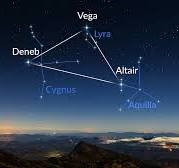
The asterism of Vega, Deneb, and Altair forms a triangle overhead. Each vertex leads to a different constellation—Lyra, Cygnus, and Aquila—rich with fascinating double stars and star clusters.
Scorpius & Sagittarius: The Milky Way’s Heart
Look to the south after dark for Scorpius’s curved tail and red Antares; to its left is Sagittarius, whose “Teapot” asterism pours “steam” right into the brightest stretch of the Milky Way—perfect for binoculars or telescope scanning.
Cygnus, the Swan
Also known as the Northern Cross, Cygnus soars through the thickest part of the Milky Way, offering beautiful sights like the double star Albireo (golden and blue) and the North America Nebula.
Perseus & Cassiopeia

Rising in the northeast after midnight, these constellations contain the Perseid meteor radiant and the sparkling Double Cluster.
5. Deep-Sky Wonders: Nebulae, Clusters, and the Milky Way
August is glorious for exploring deep-sky objects. Here are a few family favorites:
- Lagoon Nebula (M8, Sagittarius): A glowing cloud teeming with newborn stars. Visible in binoculars as a misty patch; telescopes reveal greater detail.
- Hercules Cluster (M13): A vast ball of hundreds of thousands of stars—easily found in binoculars between Vega and Arcturus.
- The Double Cluster: In Perseus, two clusters packed with hundreds of stars, giving a 3D effect in binoculars.
6. Unique Celestial Events in August 2025
| Date | Event | How and When to See |
|---|---|---|
| August 4 | New Moon | Perfectly dark skies for deep-sky observing |
| August 11–13 | Perseid Meteor Shower Peak | After midnight, northeast sky |
| August 16 | Saturn at Opposition | All night, southeast sky, telescopic viewing |
| August 19 | First Quarter Moon | Moon high at sunset, great for beginners |
| August 25–27 | Moon passes near Jupiter | East, after sunset, perfect for a twin-view |
| August 28 | Full Sturgeon Moon | Rises at sunset, large and golden |
7. Tips for Beginners and Advanced Stargazers
- Start Simple: Use your eyes for meteors and bright planets; try binoculars for star clusters.
- Set the Mood: Turn off all lights, let your eyes adapt for 20 minutes, and lie back for comfort.
- Use Technology: Free apps (like Star Walk, Stellarium, SkySafari) help you find constellations and planets in real time.
- Telescope Challenges: Advanced users, try hunting for faint planetary nebulae, supernova remnants (like the Veil Nebula in Cygnus), or the subtle colors of Albireo.
- Keep a Logbook: Record what you see—drawing, writing, or snapping smartphone pictures.
8. Family-Friendly Astronomy Activities
- Meteor Shower Party: Bring snacks and sleeping bags, and make it a summer tradition!
- Planet Hunt: See who in the family can find the most planets with unaided eyes or binoculars.
- Moon Phases Diary: Sketch or photograph the changing face of the Moon each night.
- Shadow Play: Use the bright August full moon to make moonshadows on the grass—kids love it!
9. Safety, Comfort, and Fun: Making Your Skywatch Special
- Dress Smart: Even in August, nights get cool—bring layers and bug spray.
- Pick the Right Spot: The farther you are from bright city lights, the more you’ll see. National Parks and rural areas are ideal.
- Red Flashlights: Preserve your night vision with red LED flashlights.
- Respect Nature: Leave no trash, stay on paths, and be mindful of wildlife.
10. References & Further Reading
- American Meteor Society – Perseid Meteor Shower 2025 Guide
- Sky & Telescope – August 2025 Night Sky Events
- NASA Night Sky Network – Planets and Meteor Showers in August 2025
- Star Walk – August Astronomy Calendar & Event Details
- Royal Astronomical Society – Family Stargazing Resources
- Time and Date – Planetary Events and Moon Phases August 2025
- EarthSky – Exploring Summer Constellations
- Astronomy Magazine – Deep Sky Objects for August
- Stellarium Web Online Star Map – Free, Interactive Star Charts
Footnotes:
- Meteor shower rates indicate maximums for dark, moonless, rural skies; suburban/city locations will see fewer meteors.
- Planet rise/set times vary by your geography—consult a sky app for exact timing at your location.
- Telescope recommendations assume a common entry-level or family telescope (60–90mm aperture).
In Summary: August’s Sky—A Nightly Invitation
August 2025’s night sky promises awe and discovery for every age and skill. Whether you’re spotting your first Perseid, showing a child the rings of Saturn, or photographing clusters deep in the Milky Way, the universe is open for exploration. So grab your family, friends, or simply your own sense of curiosity—and take your place under a sky sparkling with stories millions of years in the making. Clear skies and happy stargazing!
For more detailed charts, timeline planning, and expert tips, visit the American Meteor Society, NASA Night Sky Network, or your local planetarium’s monthly guide.
 Stan's Hobbies and Interests