Galaxy Season and The Pink Moon: Your Ultimate April 2026 Stargazing Guide

Welcome to April, fellow travelers of the night sky! If March was the “thaw,” then April is the “bloom”—not just for the flowers in our backyards here in Kentucky, but for the light reaching our telescopes from across the cosmos.

This month, we are turning our eyes away from the local stars of the Milky Way and peering into the vastness of intergalactic space. Grab a warm jacket and a thermos of coffee; it’s time for Galaxy Season.

1. The Lunar Cycle: Tracking the Pink Moon
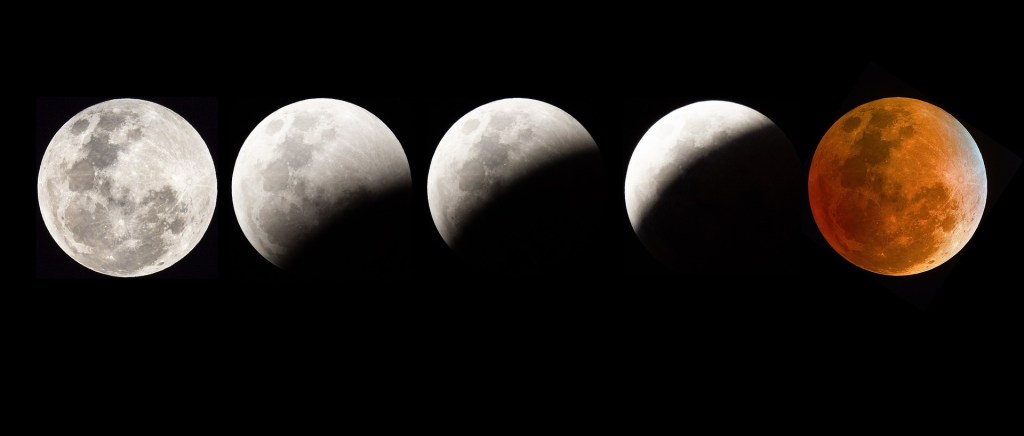
In the world of astronomy, the Moon is both our greatest subject and our biggest “light polluter.” Planning your month means working around her glow.

  • April 1: The Full Pink Moon – Rising in the constellation Virgo, this Moon is named for the creeping phlox that blankets the ground this time of year. While the “Full” phase is beautiful to the naked eye, it’s actually the worst time to see craters because there are no shadows.
  • April 17: The New Moon (The Deep-Sky Window) – This is the most important date on your calendar. From April 14th to the 20th, the sky will be at its darkest. This is your window to hunt for the faint “fuzzies” like the Leo Triplet.
  • April 24: First Quarter – My personal favorite for families. Look at the Lunar Apennines, a mountain range on the Moon that stands out in sharp relief tonight.

2. The Planet Parade: A Morning and Evening Show

2026 is giving us a split-shift for the planets. You’ll find beauty both as the sun sets and before it rises.

The “Jewel and the Necklace” (April 19)
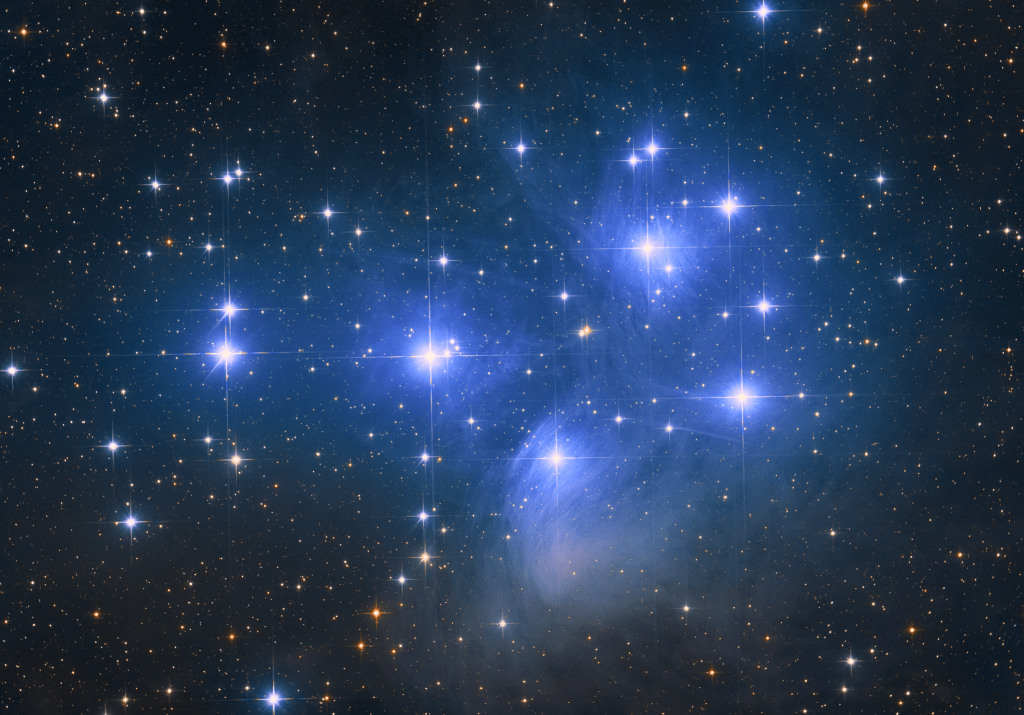
If you only look up once this month, make it the evening of April 19. In the West, the brilliant planet Venus (the “Evening Star”) will climb within 2.3° of the Pleiades Star Cluster (M45).

  • Stan’s Tip: To the naked eye, it looks like a bright diamond sitting next to a tiny, misty dipper. Through binoculars, you’ll see Venus surrounded by the dozens of icy-blue stars of the Seven Sisters. It is the best photo-op of the spring.

The Pre-Dawn Triple Conjunction (April 20)

For the early birds, set your alarm for 5:30 AM. Low in the East, Mercury, Mars, and Saturn will form a tight, colorful triangle. Mars will show its distinct reddish hue, contrasting against the golden-yellow of Saturn.


3. Constellations & Major Stars: Navigating the Spring Sky

In April, the “Winter Circle” is setting, and the “Spring Triangle” is rising.

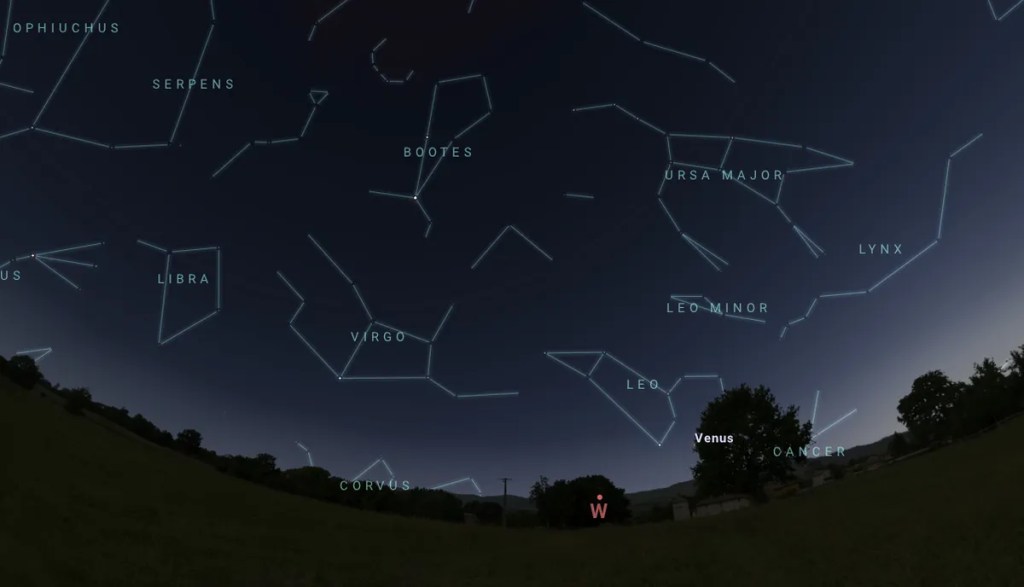
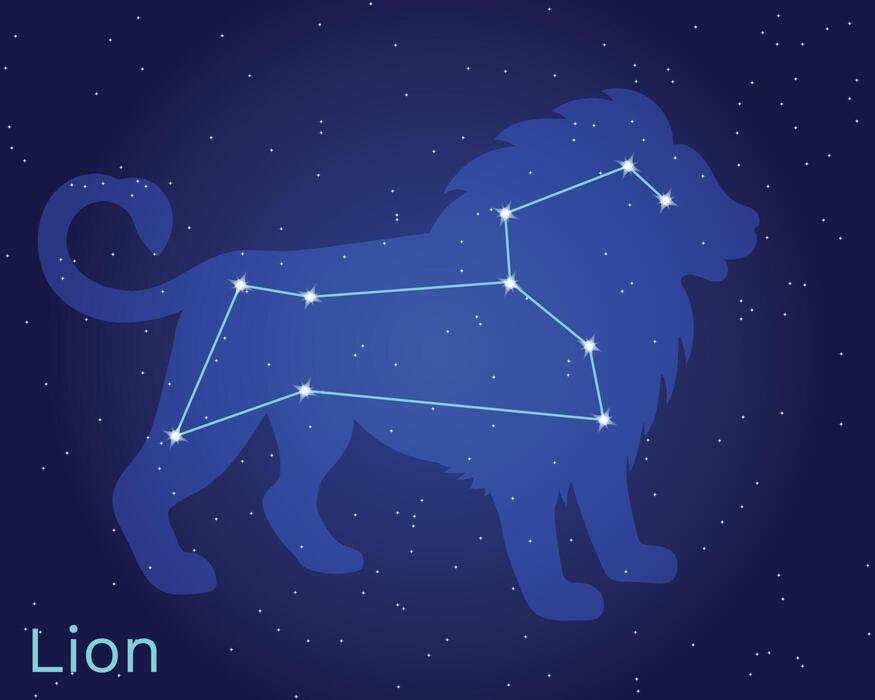
  • Leo the Lion: Look directly overhead. The “Sickle” (backwards question mark) represents the head. At the base is Regulus, a blue-white star that is 79 light-years away.
  • Boötes the Herdsman: Follow the “Arc to Arcturus.” This orange giant is the brightest star in the northern celestial hemisphere and is easy to spot rising in the East.
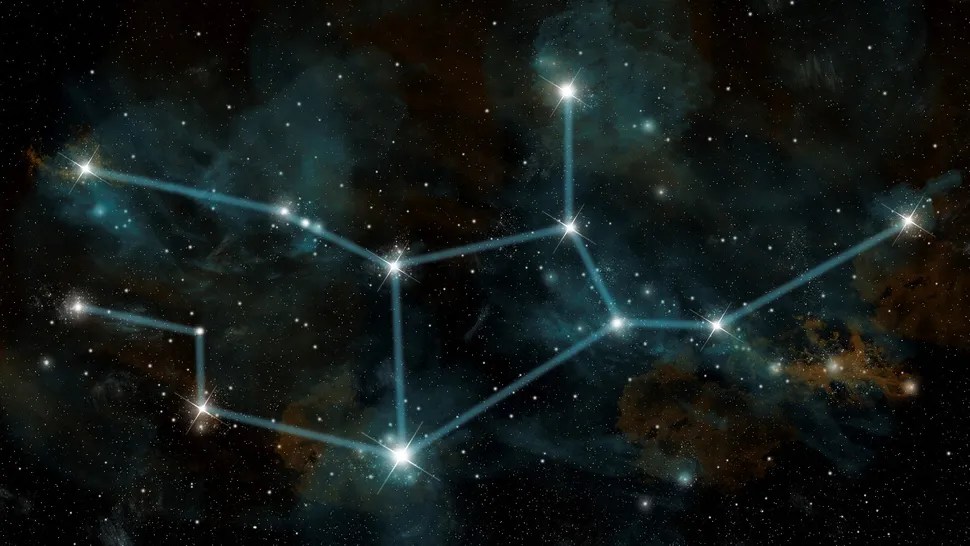
  • Virgo the Maiden: From Arcturus, “Spike to Spica.” This icy-blue star marks the heart of the region where we find the great Galaxy Cluster.

4. Major Events: Meteors and Comets

The Lyrid Meteor Shower (April 21–22)

This video is relevant because it visually demonstrates the “Arc to Arcturus” and the positioning of the Virgo Cluster, making it much easier for beginners to find these objects in the actual sky.

This is a “Dark Sky” year for the Lyrids! Since the Moon is a thin crescent and sets early, the sky will be perfectly dark for the peak. Expect 15–20 meteors per hour. Look toward the bright star Vega in the constellation Lyra to find the “radiant” point.

The 2026 Comet Wildcards

April 2026 features two potential naked-eye comets.

  1. Comet MAPS (C/2026 A1): After swinging around the sun on April 4, look for a growing tail in the Western twilight between April 10–15.
  2. Comet PanSTARRS (C/2025 R3): Reaches its closest point to Earth on April 26. Look for it in Pisces low in the East before dawn.

5. Deep-Sky Hunting: Galaxy Season

This is the heart of my April column. When you look toward Virgo, you are looking through a “hole” in our own galaxy’s dust.

  • The Leo Triplet (M65, M66, NGC 3628): Located just below the “hindquarters” of Leo. These three spiral galaxies are 35 million light-years away.
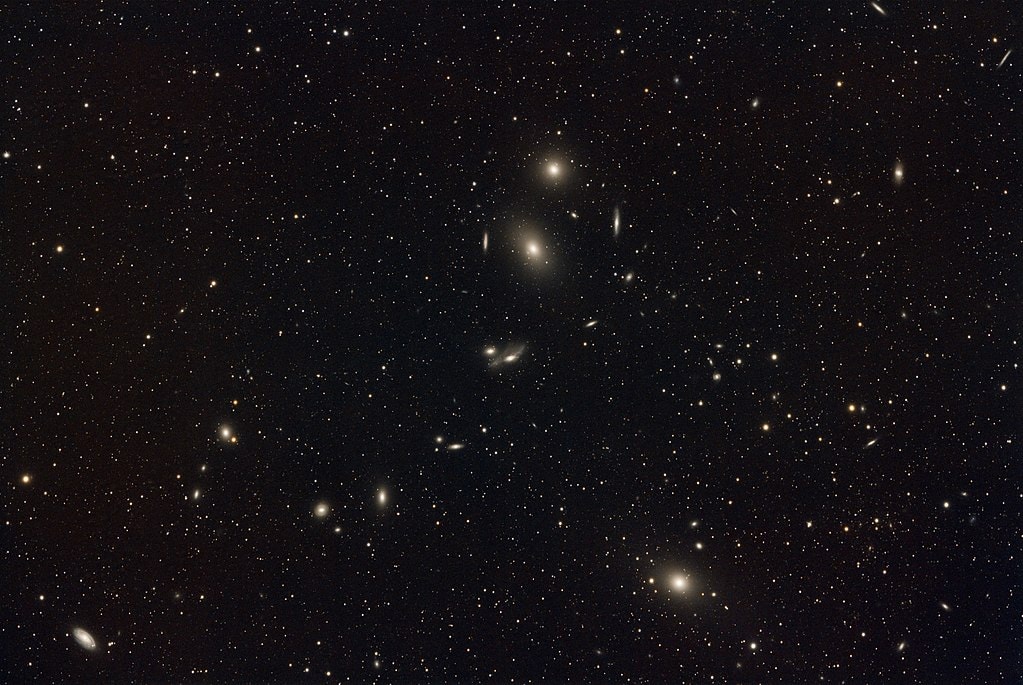
  • Markarian’s Chain: In the heart of Virgo, you can see a curved line of eight galaxies. It looks like a “Chain of Pearls” floating in the void.
6. Stan’s Gear Recommendations for April

To make these observations successful, especially for the family, here is what I’m using this month:


7. Why Stargazing Matters for the Family

Astronomy is a lifelong endeavor. It teaches patience, curiosity, and a sense of scale. When you stand in the backyard with your kids or grandkids and point at light that has been traveling since the time of the dinosaurs, you aren’t just looking at stars—you are sharing a moment of cosmic history.

Stan’s Pro-Tip: Use a Nitecore NU25 Red Light Headlamp. It keeps your hands free to handle charts while protecting your “night eyes,” which take 20 minutes to fully adjust but only a second of white light to ruin!

Tease for May: The Return of the King

Make sure to come back next month! In May, we turn our buckets toward the “King of the Planets,” Jupiter, as it makes a spectacular return to the evening sky. We will also explore the Hercules Cluster, a “snowball” of 300,000 stars that is the crown jewel of the summer sky.
Stargazing the Spring Shift: Your 2026 Guide to the March & April Celestial Theater

The transition from March to April is one of the most poetic moments in the astronomical calendar. As the “Winter Hexagon” of bright stars like Sirius and Orion bows out in the west, the curtain rises on a deeper, more mysterious stage. This is Galaxy Season, a time when the Earth’s night side points away from the crowded disk of our own Milky Way and out into the vast, silent reaches of intergalactic space.


1. The Main Attractions: Constellations to Watch

Leo the Lion: The Royal Landmark

Leo is the undisputed king of the spring sky. Visible throughout March and April, it is one of the few constellations that actually resembles its namesake.

  • How to Find It: Look for the “Sickle,” a backwards question mark that forms the Lion’s head.
  • Key Star: At the base of the Sickle sits Regulus, the “Heart of the Lion.”
  • The View: By late March, Leo sits nearly at the zenith (directly overhead) around 10:00 PM, providing the clearest possible views through the atmosphere.

Virgo: The Gateway to Other Worlds

Rising behind Leo is Virgo, the second-largest constellation. It is the “Capital City” of Galaxy Season.

  • The “Arc to Arcturus”: Follow the curve of the Big Dipper’s handle to the bright orange star Arcturus, then “Spike to Spica”—the brilliant blue-white star in Virgo.
  • The Virgo Cluster: This region contains over 1,300 galaxies. With a telescope, you can see Markarian’s Chain, a curved string of eight galaxies floating in the void.

2. 2026 Special Events: Meteors, Planets, and the ISS

  • The International Space Station (ISS): Between March 18 and 25, the ISS will make high, bright passes. It looks like a steady, fast-moving white light. Use the NASA App or Spot the Station for exact timings.
  • The March Equinox (March 20): Day and night are equal. In the North, spring begins; in the South, autumn arrives.
  • Venus & The Pleiades (April 19): Look West after sunset. The “Evening Star” (Venus) will sit just 2.3° from the Pleiades (Seven Sisters). A thin crescent Moon will join them, creating the most beautiful alignment of the year.
  • The Lyrid Meteor Shower (April 21–22): Peak occurs after midnight on April 21. With the Moon setting early, the sky will be dark enough to see 15–20 meteors per hour.

3. The “Star Hopper’s” Guide to the Leo Triplet

For telescope users, finding the Leo Triplet (M65, M66, and NGC 3628) is a must.

  1. Locate Chertan: Find the middle star in the triangle of Leo’s hindquarters.
  2. Hop South: Move your telescope halfway toward the star Iota Leonis.
  3. Scan for “Fuzzies”: At low power, you will see three distinct, ghostly smudges—each a spiral galaxy 35 million light-years away.

4. Pro-Tips: Backyard Telescope Setup

  • Daytime Alignment: Align your finder scope during the day. Center a distant chimney in your eyepiece, then adjust the finder’s screws until its crosshairs match perfectly.
  • The “Infinity” Focus: Don’t focus on a dim galaxy. Focus on a bright star like Regulus until it is a sharp, tiny point. Your telescope is now perfectly focused for the entire universe.
  • Averted Vision: To see more detail in a galaxy, look slightly to the side of it in the eyepiece. Your peripheral vision is more sensitive to faint light!

5. Gear Guide: Recommended Products for 2026

Enhance your stargazing with these top-rated tools. (Check these out at major retailers like Amazon or OpticsPlanet.com).

Product CategoryRecommendationWhy It’s Great
Best All-Rounder TelescopeCelestron StarSense Explorer DX 130AZUses your phone to guide you to galaxies like the Leo Triplet—no manual searching required!
Best BinocularsCelestron SkyMaster 15×70Perfect for the Venus-Pleiades conjunction; captures both in one high-detail field of view.
Smart TelescopeZWO Seestar S50 / S30 ProFully automated; takes photos of galaxies and sends them to your phone or tablet instantly.
Night Vision ToolNitecore NU25 Red Light HeadlampKeeps your hands free and protects your night vision with its dedicated red-light mode.
Essential AppSkySafari 8 PlusThe gold standard for sky mapping, ISS tracking, and planning your April 17 “Dark Sky” night.

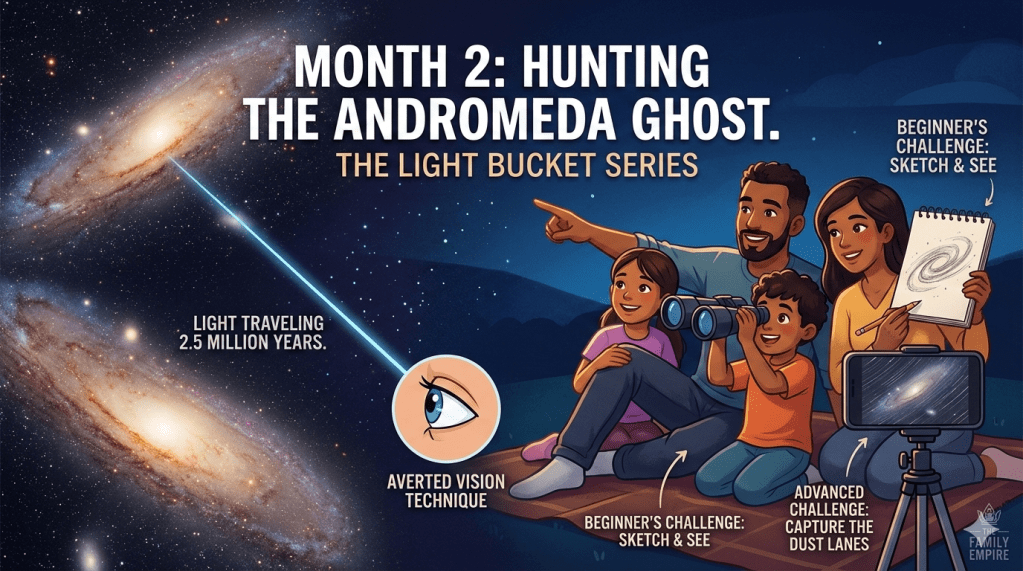
Month 2: The Andromeda Galaxy – Hunting a Ghost with Your Light Bucket.

Welcome back to The Family Empire’s year-long journey through the cosmos! In January, we introduced the core philosophy of this series: The Camera as a Light Bucket. We learned that whether you are using your eyes, a smartphone, or a professional DSLR, you are essentially holding a bucket out in a “rainstorm” of light.

This month, we are moving from theory to the ultimate test. We are going to hunt for the Andromeda Galaxy (M31). This isn’t just another star; it is a “city” of one trillion stars, and it holds the title of the most distant object the human eye can see.

When you look at Andromeda, you aren’t just looking across space—you’re looking back in time. The light hitting your “bucket” tonight left that galaxy 2.5 million years ago. To put that in perspective, when those photons began their journey, our ancestors were just beginning to use stone tools.


The Newbie’s Guide: What is a “Deep Sky Object”?

If you’re new to the hobby, “Deep Sky” sounds like something from a sci-fi movie. Simply put, it refers to anything outside our solar system that isn’t a single star. This includes nebulae, star clusters, and galaxies.

Andromeda is our closest galactic neighbor, but because it’s so far away, its light is spread out. In a “Light Bucket” sense, the raindrops are falling very far apart. If you look directly at it, your eye might not catch enough “drops” to register an image. That’s why we use a secret weapon: Averted Vision.

The Science of Averted Vision: Your eye’s center (the fovea) is great for reading and bright light, but the edges of your retina are packed with “rods,” which are much more sensitive to low light. By looking slightly to the side of the galaxy, you’re using the more sensitive part of your “bucket” to catch the signal.


The Mission: Finding the Ghostly Smudge

Finding a galaxy for the first time is a rite of passage. Here is your family treasure map:

  1. Find the “W”: Look toward the North for Cassiopeia. It looks like a giant, slightly squashed “W” or “M”.
  2. Follow the Arrow: The right-hand “V” of the W acts like an arrowhead. It points almost directly down toward a bright star called Mirach in the constellation Andromeda.
  3. The Hop: Look just above Mirach for two dimmer stars. If you follow that line, you will see a faint, oval-shaped “smudge.”

Family Tip: Use a pair of 10×50 Astronomy Binoculars to make the “smudge” pop. Binoculars are essentially two medium-sized light buckets that make the hunt much easier for kids.


The February Challenges

We want everyone to grow this year, so we’ve designed two challenges to push your skills.

The Beginner Challenge: The “Sketch and See”

Your goal isn’t just to see it, but to observe it.

  • The Task: Once you find the smudge, grab a piece of paper and a pencil. Try to sketch the shape.
  • The Twist: Use averted vision. Does the smudge get bigger when you look away? Can you see a brighter core in the center? Sketching forces your brain to process the light more deeply, making your “internal bucket” more efficient.

The Advanced Challenge: Catching the Dust Lanes (Untracked)

For those who have a DSLR or a modern smartphone with a “Night” mode, your challenge is to capture the extinction of light.

  • The Gear: A tripod is mandatory. Use a Basic Camera Tripod or a Smartphone Tripod Mount.
  • The Task: Take a series of 1-second to 2-second exposures. Any longer and the stars will “trail” (turn into lines) because the Earth is spinning.
  • The Goal: Stack these photos using free software like DeepSkyStacker. Your advanced goal is to reveal the dust lanes—the dark rings of cosmic soot that wrap around the galaxy. This requires your “bucket” to stay open for a long time (electronically) to gather enough light to see the contrast between the stars and the dust.

Why We Do This: The Family Empire Perspective

This hobby isn’t just about gadgets; it’s about perspective. Standing in the dark with your family, hunting for a light that has been traveling since before the Ice Age, reminds us how small—and how significant—we are.

As we grow this “Family Empire” together, we aren’t just learning to use cameras; we’re learning to appreciate the scale of the universe. It’s a hobby that grows with you. One night you’re looking at a smudge; the next year, you’re photographing spiral arms.


Gear Spotlight

To help keep our “Light Bucket” series running, check out these vetted tools for February’s hunt:


Next Month: Dealing with “Overspill”

In March, we turn our buckets toward the brightest thing in the sky: The Moon. We’ll learn what happens when our light bucket gets too much rain and how to handle contrast so we can see the jagged shadows of lunar craters.

Did you find the smudge? Tag us in your “Light Bucket” photos or tell us about your first Andromeda sighting in the comments!