Getting that First Batch of Beer Brewing

Beer is such a popular beverage because it has such a deep earthy flavor and because the variety of flavors, brands, colors and textures of beers is so diverse that you can explore a new brew each and every time you want a beer and never get bored. And yet most of us pretty much settle on one taste and stick with it. That is until we discover brew pubs. That is when our eyes are opened to the idea that we don’t have to depend on Budweiser and Miller for good beer. It can be made right at home.


Some of the finest beers you could hope to taste are not made in the big commercial factories but in small brew pubs all around the country. So if you have discovered some particularly flavorful home brewed beers, it isn’t long before you might decide to take a stab at brewing a batch yourself. Be careful because once you start experimenting with brewing your own beer, you may become hooked into an addictive hobby that will provide hours of fun as you tinker with your recipes, get new and better equipment and become a true beer expert in brewing your own custom blends for the best flavored beer.
But it all starts with that very first batch. You might approach that moment when you decide to make your first batch of beer with some fear and trembling. But keep your spirit of adventure and experimentation because, after all, if you bought good equipment, you will get the hang of it. As the wise man said, that the journey of a hundred miles begins with the first step. So too your journey toward becoming a master brewer starts with your first batch.


The process of brewing that first batch is pretty simple actually. Here are the steps to go through to get your first brew underway.
… Gather the ingredients to have them on hand as you step through the brewing process. You don’t’ want to have to stop and go dig something up so have them ready to go when they are added in as the brewing process is underway.
… It all starts with water. One gallon of good water will do. You don’t need specialty water as tap water in most areas of the country does well due to a good combination of minerals that actually makes the beer taste better. So get a gallon of water boiling in a large pot capable of holding 2-3 gallons of water. You need that extra space for adding ingredients.
… The first ingredient to add to the boiling water is the brewing yeast that you bought just for this purpose. The yeast will have specific instructions but in essence you will mix the yeast with piping hot tap water and stir it in a separate pot or pan until it becomes a thick paste.
…You can prepare the yeast while the water boils and when it’s ready, add the mixture to the water.
… Once the yeast is mixed in well, add the malt extract that you bought for this brewing process. Make sure the malt is mixed in well and dissolved before moving on.
… Hops will come as pellets when you bought them from the supplier so add them when the water is boiling again and allow the entire mixture to boil for another five minutes.
…During this preparation time, get your fermenting equipment sanitized and ready to go. As the brewing process approaches completion, fill the fermenter about three quarters full with cold water from the tap.
… The strong beer you have boiled is called the “wort” which is now ready for fermenting. Pour the hot wort into the cold water in the fermenter. What you are looking for is an end result of five gallons of mixture in the fermenter so if you don’t find you are at that level, add more water.


The brewing process is done and you can follow the directions for fermenting that are provided with the equipment or that you learn from other resources about the fine art of fermenting beer. Now it’s just a matter of letting nature do what it does to ferment your beer. Enjoy the anticipation as you allow the fermenting to continue and then enjoy the flavor of your very own first batch of home brewed beer.

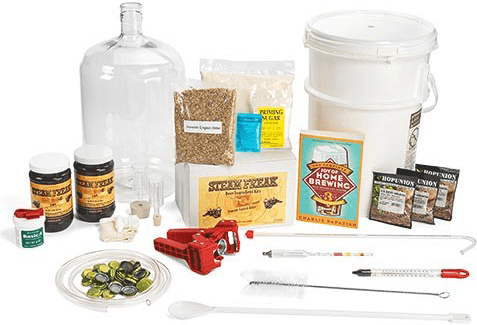
Getting Started: Essential Home Brewing Equipment List

I’m frequently asked by craft beer fans what they need in order to start brewing their own beer. Is there a home brewing equipment list that one could follow? Luckily, E. C. Kraus has taken the guess work out of this question by offering a Starter Home Brew Kit, which includes a bunch of equipment and one ingredient kit for the homebrewer’s first batch of beer. The only thing not included is a large kettle, which you may have on hand already. (If you don’t, we can hook you up with a brew kettle, too!)

Now, let’s take a closer look at the list of home brewing equipment included in the Steam Freak beer brewing kit:

  • Home Brewing Book:
    Before even getting to the actual equipment, every brewer needs some literature to guide them through their first batch. The Complete Joy of Home Brewing is the perfect accompaniment for the beginning brewer. After getting a batch or two of homemade beer under their belt, homebrewers can upgrade to more advanced books. I recommend Marty Nachel’s Homebrewing for Dummies and Ray Daniels’ Designing Great BeersMore >>
  • 6 Gallon Primary Fermenter (Comes with airlock, stopper, and faucet):
    6 Gallon Fermenter is ideal for primary fermentation. Even though you will be brewing a five-gallon batch, the extra space allows for krausen, or foam, to build during the height of fermentation. The airlock and stopper allow carbon dioxide – a byproduct of fermentation – to escape from the fermenter, while the faucet makes it easy to transfer to the carboy for secondary fermentation. More >>
  • 5 Gallon Plastic Carboy (Comes with airlock, stopper, and faucet):
    The carboy is where the beer sits for a 10-14 day conditioning phase, known as secondary fermentation. A curved racking cane will make it easier to transfer from the carboy back into the fermenter for bottling. More >>
  • Home Brew Hydrometer:
    This nifty tool should on any home brewing equipment list. It allows brewers at every level to determine the alcohol content of their beer. Carefully place the sanitized home brew hydrometer in the unfermented wort to take the first measurement – referred to as the original gravity (OG). After fermentation, take another – called the final gravity (FG). The difference between the two is used to calculate the alcohol by volume (ABV)! More >>
  • Thermometer:
    Your fermentation temperature matters. Too cool, and the yeast won’t ferment; too warm and you are promoting bacterial growth and possible death of the yeast. More >>
  • 6′ Length of 3/8″ Vinyl Hose:
    Any home brewing equipment list is going to have this. The heat resistant hose facilitates transferring from one fermenter to the other. More >>
  • Bottle Capper  
    When it’s time to bottle your brew, you’ll need something to cap the beer bottles. The double lever capper is easy to operate and ensures a firm seal on every bottle. More >>
  • Cleaner/Sanitizer:
    Brewing can get a little messy, but with several cases of beer at the end, it’s well worth the effort. A cleaner is ideal for cleaning your home brewing equipment before and after brewing a batch of beer. More >>
  • Beer Bottle Brush:
    Homebrewers typically save beer bottles for when their home brew is ready. The beer bottle brush helps to clean the insides of the bottles, helping to make sure nothing contaminates the beer you’ve worked so hard to make. More >>
  • Beer Ingredient Kit:
    Choose from over 30 beer ingredient kits for your making your first batch of beer. The Steam Freak Ingredient Kits include all home brewing ingredients for a five gallon batch, recipe instructions, and caps. More >>

Check out this great video about the Beginning Homebrew Kit

So what are you waiting for? Order a kit already and start brewing! It has a home brewing equipment list that is perfect for the first-timer. And, it’s something you can easily build upon as you progress in this wonderful hobby.

Below you will find a listing for Beginning Homebrew Kit containing the equipment needed, also there are several recipe kits available. What is your favorite beer? If you see it or one similar make note. Read the product description and the questions and answers also watch the video. See how easy a beer kit an be. Try one, enjoy the results of your efforts. Start your new hobby and share it with family and friends. You never know your beer could be in great demand. Once you have the equipment kit the recipes are endless. Make several types for poker night or the game party.


—–
David Ackley is a beer writer, brewer, and self-described “craft beer crusader.” He is a graduate of the Siebel Institute of Technology’s “Start Your Own Brewery” program and the Oskar Blues Brew School in Brevard, NC.