Have you ever looked up at the night sky and wondered about those bright, steady lights glowing overhead? You don’t need a telescope, complex computer gear, or expensive equipment to explore space. Some of the most amazing worlds in our solar system can be seen using nothing more than your naked eyes (your own unaided sight)!
In astronomy, five special worlds are known as the naked-eye planets: Mercury, Venus, Mars, Jupiter, and Saturn. To the bare eye, they look like bright, colorful “stars” that don’t twinkle.
Whether you are brand new to skywatching or looking for a fun family activity right from your backyard, here is your ultimate beginner’s guide to spotting our neighbor worlds!
The Secret Trick: Stars Twinkle, Planets Don’t!
When you step outside at night, how do you tell a distant star from a nearby planet? It’s all about the twinkle!
- Stars Twinkle: Stars are trillions of miles away. Their light travels as a tiny, razor-thin pinpoint that gets bent and bounced around by Earth’s moving atmosphere (air currents). This makes them look like they are blinking or flickering.
- Planets Shine Steady: Planets are much closer to Earth. Through the sky, they appear as tiny discs rather than pinpoints. Because more light reaches your eyes, atmospheric movement doesn’t disrupt the beam as easily. Planets glow with a calm, steady light.
1. Mercury: The Swift Twilight Beacon
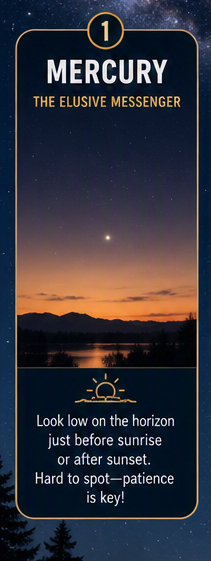
Mercury is the closest planet to our Sun, speeding around it in just 88 days! Because it stays so close to the Sun’s bright glare, it never appears high in the dark midnight sky.
How to Spot It:
Mercury is known as an elusive (hard to catch) target. You can only spot it low on the horizon during twilight—the colorful, warm glow in the sky right after sunset or right before sunrise.
Look low toward the horizon where the sun just went down or is about to rise. Mercury will appear as a bright, pinkish-orange pinpoint peeking through the twilight color!
Observer’s Helper: While you can easily spot Mercury with your bare eyes once you know where to look, a light pair of compact binoculars like the Celestron Cometron 7×50 Binoculars can help you sweep low along a colorful horizon to lock onto it faster!
2. Venus: The Dazzling Evening & Morning Star
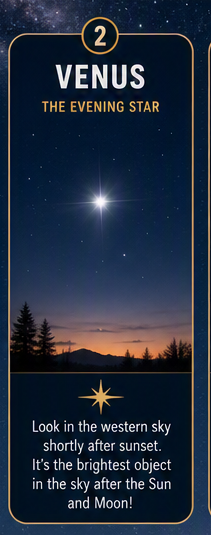
Venus is the absolute queen of the night sky! It is the third-brightest object in the entire sky, beaten only by the Sun and our Moon. It shines so brilliantly that people often mistake it for a landing airplane or a high-altitude balloon.
What to Look For:
Venus is covered in thick, white clouds that act like a giant mirror, reflecting sunlight back across space directly to your eyes.
- Evening Star: When Venus is west of the Sun, it hangs high in the twilight sky right after sunset.
- Morning Star: When it moves to the east of the Sun, it wakes up early, blazing brightly in the dawn sky before sunrise.
When Venus is at its brightest, see if you can head out to a dark park—it can actually cast faint, subtle shadows on the ground!
3. Mars: The Rusty Red Wanderer
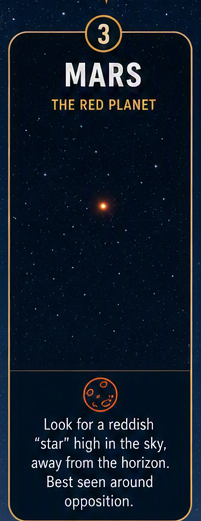
Mars is world-famous as the “Red Planet,” and your naked eyes can easily confirm its famous nickname!
Why is Mars Red?
The surface of Mars is covered in iron-oxide dust—which is the exact same material as real rust on Earth! When sunlight hits Mars, that rusty dust bounces a distinct, warm salmon-pink or deep orange light across space to your eyes.
What to Look For:
Look up for a bright, reddish-orange beacon that shines steady without flickering. Every two years, Earth and Mars come extra close to each other in an event called opposition. During opposition, Mars grows dramatically brighter in our night sky, outshining almost every star around it!
4. Jupiter: King of the Planets
Jupiter is the largest planet in our entire solar system—more than 1,000 Earths could fit inside it! Because it is so massive and covered in bright, reflective gas clouds, it is a magnificent sight to naked-eye stargazers.
What to Look For:
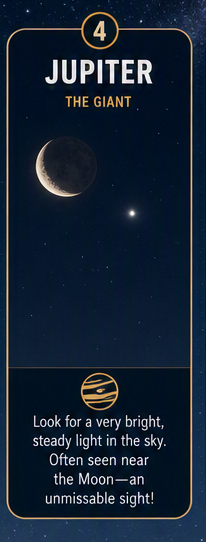
Jupiter shines with a bold, creamy-white light that dominates whichever constellation it happens to be visiting. It is often the brightest object in the midnight sky when Venus has already set.
Fun Family Challenge: While your naked eyes reveal Jupiter’s bright cream-colored disc, holding a basic pair of Bushnell Falcon 10×50 Binoculars steady against a fence post will let you spot up to four tiny pinpoints of light holding hands beside it—Jupiter’s famous Galilean Moons (Io, Europa, Ganymede, and Callisto)!
5. Saturn: The Golden Jewel

Saturn is the farthest world you can easily see with your bare eyes without any optical help at all. It sits nearly a billion miles away from Earth!
What to Look For:
To your naked eyes, Saturn doesn’t show its famous rings, but it glows with a lovely, distinct golden-yellow hue. It moves very slowly across the stars, taking nearly 30 years to make one full trip around the Sun!
Because it shines with a warm, steady golden light, it is easy to pick out against the harsh, blue-white flickering stars surrounding it.
Naked-Eye Planet Hunting Checklist
| Planet | Color to Look For | Best Time to Spot It | Secret Sky Hint |
| Mercury | Pinkish-Orange | Twilight (Dawn/Dusk) | Stays very low to the horizon |
| Venus | Brilliant Silver-White | Just after Sunset or before Sunrise | Brighter than any star in the sky |
| Mars | Rusty Salmon-Red | High in Dark Night Sky | Noticeable orange/red color |
| Jupiter | Bright Cream-White | Midnight Hours | Shines steady with zero twinkling |
| Saturn | Warm Golden-Yellow | Evening & Midnight | Farthest planet seen with bare eyes |
Three Easy Tips for Backyard Skywatchers
- Give Your Eyes Time to Adjust: When you step out from a bright house into the yard, your eyes need about 15 to 20 minutes to build up “dark adaptation.” The longer you stay in the dark, the brighter the planets and surrounding stars will appear!
- Use a Red Flashlight: White light from smartphones or porch lights instantly ruins your dark adaptation. Use a red-light mode on your flashlight, like the EverBrite Red/White Headlamp, so you can read sky maps without blinding your eyes.
- Find the “Ecliptic Line”: Planets don’t just scatter randomly across the sky. The Sun, Moon, and all five naked-eye planets travel along the exact same imaginary arch across our sky called the ecliptic path. If you find the Moon, look left and right along that same general path across the sky to spot the planets!
You don’t need fancy equipment to enjoy the wonder of the cosmos. Just step outside on a clear night, look up along the moon’s path, and enjoy the front-row view of our solar system!
Clear skies and happy planet hunting!

 Stan's Hobbies and Interests