Why Astronomy Binoculars are the Ultimate Family Hobby in 2026

By Stan’s Hobbies and Interests | Updated: February 2026

For decades, the “first step” into amateur astronomy was a bulky, expensive telescope that often spent more time gathering dust in a garage than gathering light from the stars. In 2026, the landscape has shifted. Thanks to massive leaps in Extra-low Dispersion (ED) glass and Image Stabilization (IS) technology, a simple pair of binoculars is no longer just an alternative—it’s often the best way for a family to start their “Empire” in the stars.

In this guide, I’ll explain why your next family camping trip or backyard session needs a pair of “astro-bins” and how to choose the right pair for your budget.

The Binocular Advantage: Why Two Eyes Are Better Than One

Most beginners don’t realize that our brains are biologically wired to process information from two eyes simultaneously. This is called Binocular Summation. When you use a telescope (one eye), your brain has to work harder to ignore the “blank” input from your closed eye.

With binoculars, you get a 3D-like perspective of the lunar surface. The craters look deeper, and the vast star fields of the Milky Way feel like you’re looking through a window into deep space. Plus, for younger children, binoculars are much more intuitive to point and shoot than a complex equatorial mount telescope.

For the “Star-Hopping Cheat Sheet” for February go to – HERE


The 2026 Buyer’s Guide: Top 3 Recommendations

To help you find the perfect fit, I’ve selected three pairs based on the current 2026 market standards. Each serves a different “Family Empire” need.

1. The Best All-Rounder: Nikon Action EX 10×50

If you want one pair of binoculars that can do it all—from birdwatching in the morning to spotting the moons of Jupiter at night—this is it. The Nikon Action EX series has remained a gold standard because of its rugged, waterproof build and high-quality BaK-4 pr

Nikon Action EX 10×50

  • Why families love it: It’s “kid-proof” (waterproof and shock-resistant) and provides a bright 50mm aperture that sucks in light.

2. The Budget Powerhouse: Celestron SkyMaster 15×70

If your primary goal is to see deep-sky objects like the Orion Nebula or Andromeda Galaxy without breaking the bank, the SkyMaster 15×70 is the undisputed value king.

Celestron SkyMaster 15×70

  • The Trade-off: These are large. While you can hold them by hand for a minute or two, they really shine when mounted on a tripod.

3. The Tech-Forward Choice: Canon 10x42L IS WP

The biggest trend in 2026 is Image Stabilization (IS). One of the main complaints about binoculars is “image shake.” Canon’s IS technology uses internal sensors to “freeze” the stars in place, even if your hands are shaking slightly from the cold or excitement.

Canon 10x42L IS WP

  • The Experience: It’s like having a tripod built into your hands. It’s a premium investment, but for a family that values high-tech gear and portability, it is unbeatable.

Technical Breakdown: Understanding the Numbers

When looking at the specs for your purchase, you’ll see two numbers (e.g., 10×50). Here is the math that matters:

  • Magnification (10x): This is how many times larger the object appears.
  • Aperture (50mm): This is the diameter of the front lens. In astronomy, aperture is king.
  • Exit Pupil: This is the small circle of light that hits your eye. You calculate it using the formula:
  • Exit Pupil = Aperture/Magnification
  • For stargazing, you want an exit pupil between 5mm and 7mm to match your eye’s dilated pupil in the dark.

How to Get the Most Out of Your New Hobby

To truly build a family legacy of learning, don’t just look at the stars—learn them.

  1. Use an App: Tools like Stellarium or SkyGuide (updated for 2026) use AR to show you exactly where to point your binoculars.
  2. Get a Tripod Adapter: For anything over 10x magnification, a $20 L-adapter for your tripod will change your life.
  3. Averted Vision: Teach your kids this “pro” trick: look slightly to the side of a faint object. The outer part of your retina is more sensitive to light, making faint nebulae suddenly pop into view!

Final Thoughts for the “Family Empire”

Astronomy isn’t just about looking at dots of light; it’s about the conversations that happen in the dark. It’s about the “Whoa!” from your youngest child when they see the Moon’s mountains for the first time. Binoculars lower the barrier to entry, making the universe accessible to everyone in your home.


Best Astronomy Binoculars for Beginners

This video provides a visual breakdown of the top-rated binoculars in 2026, including the Celestron and Nikon models mentioned above, helping you see the size and scale of the optics before you buy.

For the “Star-Hopping Cheat Sheet” for February go to – HERE

🚀 February 2026: The Family Empire Star-Hopping Cheat Sheet

Mission Brief: Start with the most famous hunter in the sky and use his stars as “galactic signposts” to find planets, clusters, and distant galaxies.

📍 Level 1: The Hunter’s Belt (Starting Point)

Look due South around 8:00 PM. You will see three bright stars in a perfect diagonal line. This is Orion’s Belt.

  • The Goal: Find the “Sword” hanging off the belt. In the middle of that sword is a fuzzy patch.
  • What you’re seeing: The Orion Nebula (M42)—a massive star factory where new suns are being born right now!

📍 Level 2: The Dog Star (Heading South-East)

Draw a straight line through Orion’s Belt and follow it down to the left. You will hit a star so bright it often twinkles in multiple colors.

  • The Goal: Find Sirius, the brightest star in our night sky.
  • Family Fact: Sirius is part of Canis Major (the Big Dog), Orion’s faithful hunting companion.

📍 Level 3: The Seven Sisters (Heading North-West)

Go back to the Belt and follow the line up and to the right. You’ll pass the orange eye of Taurus the Bull (Aldebaran) and land on a tiny, shimmering cluster of stars.

  • The Goal: Find the Pleiades (M45).
  • Binocular Tip: Through binoculars, this “tiny cloud” explodes into dozens of icy blue diamonds.

📍 Level 4: The 2026 Planetary Line-up (The Grand Finale)

On February 20, 2026, head outside 45 minutes after sunset and look toward the West.

  • The Sight: A rare vertical line will form! From the bottom up, you will see Venus (blazing bright), Mercury, Saturn, and the Moon.
  • Challenge: Can you spot all four in one glance?

For the “Star-Hopping Cheat Sheet” for February go to – HERE

Special Comet Alert: The Arrival of Comet Wierzchos (C/2024 E1)

A “Dirty Snowball” from Deep Space Makes a Once-in-a-Lifetime Visit

Get ready to add a truly special event to your February stargazing plans! While our monthly guide highlighted the fantastic Planet Parade and the challenge of the Hidden Galaxy, there’s another celestial visitor stealing the show this month: Comet Wierzchos (C/2024 E1).

This isn’t just any comet. It’s a true wanderer from the outer reaches of our solar system, making its closest approach to Earth on February 17, 2026. What makes this so exciting? For many of us, this will be our first opportunity to witness a comet with our own eyes—a faint, ethereal “fuzzball” with a shimmering tail, a genuine relic from the dawn of our solar system.


The Discovery: A Name Etched in Cosmic History

Comets are often named after their discoverers, and C/2024 E1 is no exception. It carries the name of Polish astronomer Mariusz Wierzchos, who first spotted this icy wanderer.

Imagine the thrill! On March 15, 2024, Mariusz was diligently observing the night sky through the famous Catalina Sky Survey (CSS) telescope in Arizona. The CSS is a project specifically designed to scan the heavens for near-Earth objects—asteroids and comets that might pose a risk or simply offer a spectacular show. As he compared images taken moments apart, a faint, fuzzy smudge moved ever so slightly against the background of distant stars. It wasn’t an asteroid; its slightly blurred appearance hinted at a coma, a gassy cloud typical of a comet.

Mariusz Wierzchos wasn’t just observing; he was writing his name into the history books of astronomy. His discovery means that for decades, possibly centuries, this comet will carry his name, a testament to the patient dedication of astronomers who tirelessly monitor the vastness of space.


What IS a Comet, Anyway? The “Dirty Snowball” Explained

If you’ve never seen a comet before, you might be imagining a fiery streaking ball. But the truth is far more fascinating!

Think of a comet as a “dirty snowball” the size of a mountain, hurtling through space. These are cosmic time capsules, left over from when our solar system first formed, nearly 4.6 billion years ago. They are made of ice (water, carbon dioxide, methane, ammonia), dust, and rocky bits.

Most comets spend billions of years in the deep freeze far beyond Pluto, in regions like the Oort Cloud. But sometimes, the gravitational tug of a distant star or a passing planet knocks one of these icy mountains out of its quiet orbit and sends it plunging toward the Sun.

The Grand Transformation: How a Comet Gets Its Tail

As Comet Wierzchos approaches the Sun, something magical happens. The Sun’s warmth begins to heat up its icy core. The ice doesn’t just melt; it sublimates, turning directly from a solid into a gas. This escaping gas carries dust particles with it, creating two distinct features:

  1. The Coma: A fuzzy, glowing “atmosphere” or cloud of gas and dust around the comet’s nucleus (the icy core). This is what makes a comet look like a “fuzzball” rather than a sharp star.
  2. The Tails: Comets often have two tails!
    • Dust Tail: This is often broad and curved, made of tiny dust particles pushed away from the Sun by sunlight.
    • Ion Tail: This is usually thinner, straighter, and can glow bluish. It’s made of electrically charged gas particles pushed directly away from the Sun by the solar wind.

Comet Wierzchos: Your February Viewing Guide

This is truly a “blink and you’ll miss it” opportunity, as comets only appear this brightly for a short window.

  • Closest Approach to Earth: February 17, 2026 (approx. 94 million miles away!)
  • Best Viewing Window: From February 15 to February 25, especially around the New Moon on February 17. A moonless sky will be crucial for seeing this faint visitor.
  • Where to Look: In the early evening sky, it will be passing through the constellation Cetus the Whale. Cetus is a large, sprawling constellation that is relatively easy to find in the southern sky after sunset.

What You’ll Need (and What to Expect):

  • Naked Eye: Likely not visible to the naked eye, even under dark skies. This comet is predicted to reach about magnitude 7.
  • Binoculars (Highly Recommended!): This is your best friend for comet hunting! A good pair of 10×50 binoculars (like those found in my Astronomy Equipment Collection) will show you a distinct fuzzy patch, perhaps even with a hint of a tail.
  • Telescope: If you have a telescope, even a small one, you’ll get a better view of the coma and potentially a longer, more defined tail.
  • Dark Skies: The further away from city lights you can get, the better your chances of seeing this faint object.
  • Patience: Comets are subtle. Don’t expect a bright, spectacular show like the famous Hale-Bopp (which was a once-in-a-generation event). Take your time, let your eyes adjust to the dark, and sweep the area with your binoculars.

A Photographer’s Dream: Comet & Galaxy in One Frame!

For the avid astrophotographers out there, Comet Wierzchos offers an incredible opportunity. In late February, the comet will be passing near several distant galaxies within Cetus. Capturing a comet alongside a distant galaxy in a single photograph is a rare and highly sought-after prize in astrophotography. Set up your camera on a tripod, use a wider lens, and take multiple long exposures (similar to our “Light Bucket” technique!) to try and snag this unique cosmic portrait.


Why This Comet Matters to You

Comets are messengers from the beginning of time. They travel through space for eons, only to grace our skies for a brief, shining moment. Seeing one connect you to the vast, dynamic nature of our universe. It’s a reminder that even in our familiar night sky, there are always new wonders passing by, waiting to be discovered.

So, mark your calendars for mid-February, especially around the New Moon on the 17th. Bundle up, grab your binoculars, and step outside. You might just catch your first glimpse of a “dirty snowball” that has traveled billions of miles just to say hello.

Clear skies and happy comet hunting!


References & Footnotes:

What to See in the Night Sky: February 2026 Guide

From the “Planet Parade” to the Mystery of the Hidden Galaxy

There is a special kind of magic that happens in February. While the ground might still be covered in snow and the air holds a biting chill, the night sky is at its most transparent. For stargazers, this is “The Great Transition.” The bold, bright stars of winter are high in the south, while the first faint whispers of “Galaxy Season” are beginning to rise in the east.

Whether you are a parent looking for a 10-minute backyard activity with the kids or an avid observer ready to spend hours at the eyepiece of a telescope, February 2026 has something spectacular to offer. Put on your warmest coat, grab a thermos of cocoa, and let’s explore the universe together.


📅 The February 2026 Lunar Calendar: Planning Your Nights

In astronomy, the Moon is both a friend and a bit of a “light polluter.” When the Moon is full, its light is so bright that it washes out the faint distant galaxies and nebulae. When it’s a New Moon, the sky is a deep, velvety black—perfect for deep-space hunting.

  • Full Moon (The Snow Moon): February 1 – This is the best time to look at the Moon itself. If you have astronomy equipment like binoculars, look at the “terminator” line (the line between light and shadow) to see the shadows of lunar craters.
  • New Moon: February 17 – This is our “Dark Sky” window. If you want to see the faint “Hidden Galaxy” or the glow of the Orion Nebula, mark this date on your calendar!

🪐 The Main Event: The Late-February “Planet Parade”

The biggest news for February 2026 is a rare celestial alignment known as a Planet Parade. Starting around February 21, six of our neighbors in the solar system—Mercury, Venus, Saturn, Neptune, Jupiter, and Uranus—will appear to line up across the sky.

How to See the Parade:

This is a bit of a “Level 10” challenge because four of the planets (Mercury, Venus, Saturn, and Neptune) will be hanging very low in the west right after sunset.

  1. Find a Clear View: You need a horizon without trees or buildings.
  2. Timing is Everything: Look about 45 minutes after sunset. Venus will be the brightest “star” in the west. Mercury will be a tiny dot just below it.
  3. The Easy Wins: While the others are diving toward the horizon, Jupiter will be sitting high and proud in the constellation Gemini. It is so bright that you can see it even from a brightly lit city street.

🏹 Constellation Spotlight: Orion the Hunter

If there is one constellation that defines the winter sky, it is Orion. He stands tall in the south, recognizable by the three stars that make up his perfectly straight belt.

For the Family: A Legend in the Stars

Tell the kids the story of Orion, the giant hunter who boasted that no creature on Earth could defeat him. The gods sent a tiny scorpion to humble him, and now they are placed on opposite sides of the sky so they never meet. When Orion sets in the west, Scorpius rises in the east!

The “Star-Hop” Trick

Use Orion as your “GPS” for the sky:

  • Follow the Belt Down: It points to Sirius, the brightest star in the sky (the “Dog Star”).
  • Follow the Belt Up: It points to Aldebaran, the red eye of Taurus the Bull.
  • Check the Shoulders: Look at Betelgeuse. It’s a red supergiant star so big that if it were our sun, it would swallow up the Earth and Mars!

🌌 Mission 1: The Beginner’s Target

The Great Orion Nebula (M42)

Just below Orion’s belt hangs his “sword.” If you look closely at the middle “star” of the sword, you’ll notice it looks a little fuzzy. That isn’t a star at all—it’s a stellar nursery!

This is the Orion Nebula, a massive cloud of gas and dust where new stars are being born right now. Through binoculars, it looks like a beautiful glowing ghost. If you use the “Smartphone Light Bucket” trick we practiced, you can even capture its subtle pink and purple colors.


🔭 Mission 2: The Avid Enthusiast (The Deep Space Corner)

Target: IC 342 (The Hidden Galaxy)

For those of you who have been observing for a while and want a real challenge, this month we are hunting IC 342, also known as the Hidden Galaxy.

Why is it “Hidden”?

IC 342 is actually one of the brightest spiral galaxies in our sky, but it sits directly behind the thick dust of our own Milky Way’s equator. It’s like trying to see a bright house through a very thick forest.

How to find it:

It is located in the faint constellation Camelopardalis (the Giraffe). You won’t see this with the naked eye. You will need a telescope (at least 6 or 8 inches) and a very dark night near the New Moon on February 17th.

  • Search Tip: Find the “W” of Cassiopeia. Use the star Segin (the left-most star of the W) to hop toward the giraffe.
  • What you’ll see: Don’t expect a bright photo. It will appear as a large, very faint “smudge” of light. Use Averted Vision (looking slightly to the side of the object) to make the faint spiral structure pop!

🛠️ Stan’s Recommendation: Stability is Key

One of the biggest frustrations for beginners is “shaky stars.” Whether you are using a smartphone or a pair of 10×50 binoculars, keeping your view steady makes the difference between seeing a “fuzzy blob” and seeing a “nebula.”

I always recommend starting with a simple tripod adapter or a sturdy mount. You can find my favorite entry-level astronomy equipment right here to help you get those crystal-clear views of Jupiter’s moons or the Orion Nebula.


Conclusion: The Universe is Waiting

As we wrap up our February guide, remember that the most important piece of equipment isn’t a telescope or a high-tech phone—it’s your own sense of wonder. Whether you are identifying Orion’s Belt for the first time or hunting for a “Hidden Galaxy,” you are participating in a tradition of exploration that is thousands of years old.

The night sky in February is a bridge. It offers us the bold stars of winter and the first whispers of the distant galaxies of spring. Don’t worry if you can’t find everything on this list the first time. Half the fun of being an astronomer is the “hunt”—that moment when the clouds part and the universe reveals a little more of itself to you.

I am still learning right alongside you, and that is what makes this hobby so exciting. Grab your red flashlight, bundle up, and head outside. I’d love to hear what you found! Did you catch the “Planet Parade”? Leave a comment below or share your photos with us.

Clear skies and happy observing!


References & Footnotes

  • Planet Parade Data: Royal Observatory Greenwich, Space Highlights 2026.
  • IC 342 Information: NASA/ESA Hubble Space Telescope Galaxy Studies.
  • Moon Phases: US Naval Observatory (USNO) Lunar Calendar.

Month 1: Mission – The Camera as a “Light Bucket”

How to Reveal the Hidden Universe with Your Smartphone

Have you ever looked up at the night sky from your backyard and felt like you were looking at a giant, empty black blanket with just a few tiny holes poked in it? On most nights, especially if you live near a city, you might see the moon, a couple of bright planets, and the famous stars that make up the Big Dipper. But to the human eye, the space between those stars looks like a vast, lonely void.

Well, I have a secret for you: The sky is not empty.

Right now, directly above your head, the sky is crowded with millions of stars, swirling clouds of colorful gas called nebulae, and entire “island universes” known as galaxies. They are there every single night. The only reason you can’t see them is that your eyes aren’t designed to “catch” enough light.

Today, we are going to turn your family’s smartphone into a scientific instrument called a Light Bucket. With just 15 seconds of patience, you are going to photograph things that have been invisible to humans for thousands of years.


The Science: Why Your Eyes are “Fast” but “Weak”

To understand how we’re going to see the invisible, we first have to understand how our eyes work. Your eyes are like incredible, high-speed video cameras. They take about 30 “pictures” every single second and send them to your brain. This is why, when a friend throws a baseball at you, you can see it moving through the air and catch it.

However, there is a downside to being that fast. Because your eye “resets” so quickly, it only has a tiny fraction of a moment to catch the light from a star. If that star is very far away, your eye just doesn’t have enough time to collect the photons (light particles) before it resets for the next picture.

The Light Bucket Analogy

Imagine it is raining outside very lightly. If you hold out a tiny thimble for just one second, you might not catch a single drop. But if you put a big bucket on the lawn and leave it there for 15 seconds, you’ll find that the bucket has collected enough water to fill a whole glass.

A smartphone camera can act exactly like that bucket. We can tell the camera to keep that shutter open for 15 full seconds. During those 15 seconds, the camera sensor sits perfectly still, catching every single tiny “drop” of starlight that falls into it.


Mission Gear: What You’ll Need

The best part about modern astronomy is that you don’t need a $2,000 telescope to get started. However, to be successful, you do need a few pieces of specialized astronomy equipment to keep your camera steady.

  1. A Smartphone: Almost any smartphone made in the last few years has a “Night Mode” or “Pro Mode.”
  2. A Tripod (The Most Important Part): Remember the bucket analogy? If you wiggle the bucket, you’ll spill the “light.” If the phone moves even a tiny bit, the stars will look like messy squiggles. You can find sturdy, affordable tripods and phone mounts here: Best Astronomy Tripods & Gear.
  3. A Dark Spot: Find a spot in your yard away from streetlights.
  4. A Red Flashlight: White light “shrinks” your pupils. Astronomers use red light to see their gear while keeping their eyes adjusted to the dark. You can find red-light headlamps and flashlights in this Astronomy Equipment Collection.

The 15-Second Challenge: Step-by-Step

Step 1: Find an “Empty” Patch

Point your tripod-mounted phone at a part of the sky that looks the darkest.

Step 2: Configure Your “Bucket”

  • On an iPhone: Tap the arrow at the top, select the “Yellow Moon” icon (Night Mode), and slide it to Max.
  • On an Android: Go to “More” > “Pro” > “S” (Shutter Speed) and set it to 15s.

Step 3: Use the Self-Timer

To prevent the phone from shaking when you touch it, set your phone’s Self-Timer to 3 seconds. Tap the button, step back, and let the camera do its magic!

Step 4: The Reveal

When the timer finishes, look at your gallery. You will see a “Sea of Stars” that weren’t there before!


What are You Learning?

When you look at your photo, you are looking at real scientific data!

  • Star Population: Count the stars in your photo vs. what you can see with your eyes.
  • Star Colors: Notice the colors! Blue stars are very hot (10,000°C+), while Red/Orange stars are “cooler” (3,000°C).
  • Light Pollution: If your photo looks orange, you’re seeing “Skyglow” from city lights.

If this experiment makes you want to see even deeper into space, you might consider moving up to a pair of stargazing binoculars or a beginner telescope. You can browse high-quality options here: Explore Beginner Astronomy Equipment.


Next Month’s Mission…

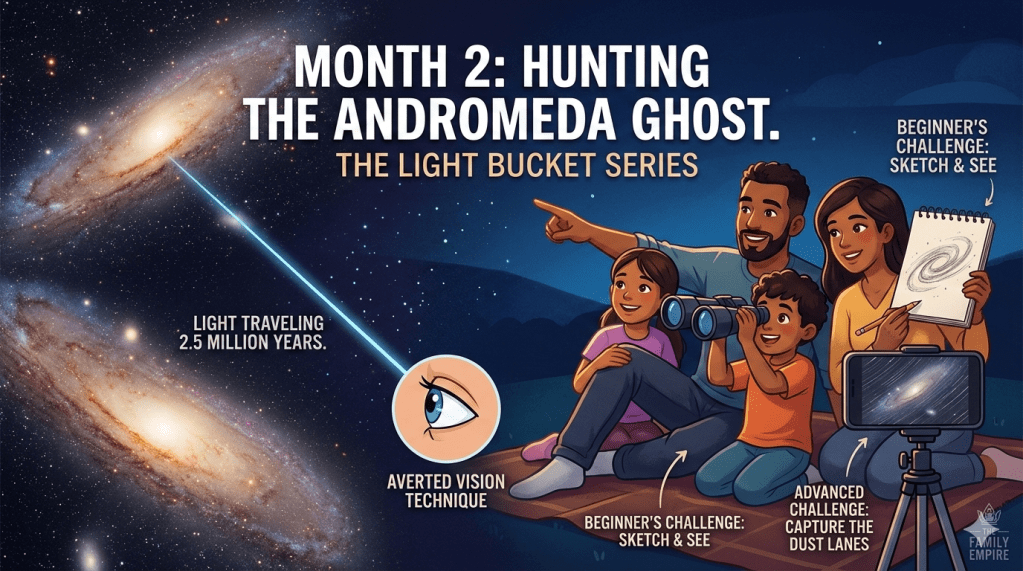
Now that you’ve mastered the “Light Bucket” technique, you’re ready for a bigger challenge. Next month, we are going to hunt for the Andromeda Galaxy—the furthest thing the human eye can see!

Clear Skies, Stargazers!


📚 References & Scientific Footnotes

  1. Light Integration: NASA – Telescope Basics
  2. Stellar Classification: American Museum of Natural History
  3. Light Pollution: International Dark-Sky Association

🌌 New Year Night Sky 2026: Family Guide to January’s Supermoon, Jupiter Show & Winter Constellations


Welcome to a brand‑new year of celestial wonder! January 2026 brings some of the brightest, boldest, and most family‑friendly sky events of the entire year. Whether you’re a seasoned stargazer or simply love sharing magical moments with your kids, this month’s night sky is packed with excitement — from a dramatic Supermoon to Jupiter’s dazzling display and the sparkling winter constellations overhead.

Bundle up, step outside, and let the universe kick off your year with awe.


🌕 January’s Supermoon: The First Big Sky Moment of 2026

The year begins with a showstopper — a Supermoon that rises big, bright, and impossible to miss. Because the Moon is closer to Earth in its orbit, it appears larger and more luminous than usual.

⭐ Why Families Will Love It

  • No equipment needed — just look up
  • Kids instantly notice the “extra big” Moon
  • A perfect moment to talk about orbits, gravity, and tides
  • Great for photos, journaling, or a quick backyard adventure

🌟 Viewing Tip

Catch the Moon right at moonrise. Near the horizon, it looks even bigger thanks to a fun optical illusion that kids love learning about.


Jupiter Takes Center Stage: The Brightest Planet of January

Jupiter dominates the evening sky all month long, shining like a cosmic beacon. Even with simple binoculars, you can spot its four largest moons — tiny dots lined up beside the planet.

⭐ Why Jupiter Is a Must‑See

  • It’s the brightest object in the night sky after the Moon
  • Its moons shift positions nightly, creating a new view every time
  • A perfect introduction to planetary observing for beginners
  • Kids love seeing “mini worlds” orbiting another planet

🌟 Family Activity

Sketch Jupiter and its moons for a few nights in a row. You’ll see them move — just like Galileo did over 400 years ago.

Check here for deals on Astronomy Equipment.


❄️ Winter Constellations: January’s Sparkling Sky Map

January is famous for crisp, clear nights and some of the most iconic constellations of the year. These star patterns are bright, easy to find, and full of stories that kids love.

Orion the Hunter

Look for the three stars of Orion’s Belt — they point directly to Sirius, the brightest star in the sky.

Taurus the Bull

Home to the fiery red star Aldebaran and the beautiful Pleiades star cluster.

Gemini the Twins

Castor and Pollux shine side by side, marking the heads of the celestial twins.

🌟 Why Winter Constellations Are Perfect for Families

  • Easy to identify
  • Great for storytelling and mythology
  • Ideal for teaching kids how to navigate the sky

🔭 How to Make January Stargazing Extra Special

Pinterest readers love simple, actionable tips — so here are family‑friendly ideas to elevate your night‑sky adventure:

  • Bring warm drinks like hot chocolate
  • Use a stargazing app to help kids identify stars
  • Keep a “sky journal” to record what you see
  • Try binoculars before investing in a telescope
  • Turn off nearby lights to make the stars pop

Deals on Astronomy Equipment.

🌌 A Magical Start to 2026

January’s night sky is a gift — bright, bold, and full of wonder. Whether you’re watching the Supermoon rise, spotting Jupiter’s moons, or tracing Orion across the sky, this month invites families to slow down, look up, and share unforgettable moments together.

Holiday Night Sky 2025: Family Guide to Late‑December Wonders

The last half of December 2025 brings some of the longest, darkest nights of the year, making it a perfect time for family‑friendly stargazing that excites both beginners and experienced astronomers. The sky offers a dark New Moon, a Christmas‑week meteor shower, bright planets, and the great winter constellations that pair beautifully with the themes of Christmas—light, hope, and wonder. starwalk+1


From the New Moon on December 20 through New Year’s Eve, the night sky of 2025 becomes a natural Christmas light show—no electricity required. Long, frosty nights in the Northern Hemisphere give everyone time to step outside and enjoy meteor showers, bright planets, and glittering constellations that have inspired stories for thousands of years. Whether you are brand‑new to astronomy or already own a telescope, the last half of December is your invitation to slow down, look up, and share the sky with those you love. timeanddate+2

This guide walks through what to see, when to see it, and how to observe each event, with tips for turning every clear night into an educational, family‑friendly adventure.


December 20: New Moon and the Darkest Skies

The New Moon on December 20, 2025, marks the darkest night of the month, because the Moon is essentially invisible in the sky. Without its glare, faint star clusters, nebulae, and even some galaxies become easier to see, especially from rural or suburban locations with less light pollution. planetary+1

For beginners, this is the ideal opportunity to learn the basic winter constellations. Look for:

  • Orion the Hunter rising in the east after sunset, with his three‑star belt forming a straight line.
  • Taurus the Bull above Orion, marked by the V‑shaped Hyades cluster and the brighter Pleiades (Seven Sisters) nearby.
  • Canis Major with Sirius, the brightest star in the night sky, shining low in the southeast later in the evening.

Experienced observers can use the New Moon sky to hunt deep‑sky treasures like the Orion Nebula (M42), the open clusters M36–M38 in Auriga, and the richly populated Pleiades through binoculars and telescopes. This is a great night to invite family or neighbors over for a “dark‑sky star party” complete with hot drinks and warm blankets. science.nasa+1


December 21: The Solstice and the Spirit of Christmas

The December solstice occurs on December 21, 2025, marking the official start of winter in the Northern Hemisphere and the longest night of the year. Many Christmas traditions—candles in windows, strings of lights, and the story of a guiding star—are rooted in this turning point from deep darkness toward lengthening days. blogs.loc+1

A simple family tradition is to step outside on solstice evening, look up at Orion, the Pleiades, and Jupiter or Saturn if visible, and talk about how people have used the sky to mark seasons and celebrations for thousands of years. For Christian families, this is a natural time to discuss the “Star of Bethlehem” and how ancient skywatchers interpreted unusual celestial events as meaningful signs. rmg+2


December 21–22: The Ursid Meteor Shower

Just after the solstice, the Ursid meteor shower reaches its peak around the night of December 21–22. The Ursids are not as intense as the earlier Geminids, typically producing around 10 meteors per hour under dark skies, but in 2025 they benefit from very favorable conditions: the peak occurs just two days after New Moon, so the sky is wonderfully dark. starwalk+1

How to watch the Ursids

  • Best time: After midnight until the pre‑dawn hours, when the radiant in Ursa Minor (near the Little Dipper) climbs higher in the sky. starwalk
  • Where to look: Do not stare only at the Little Dipper; instead, look about 40° away from the radiant for longer meteor trails. Meteors can appear anywhere in the sky.
  • What you need: No telescope is required. A reclining lawn chair, warm layers, blanket or sleeping bag, and a thermos of hot chocolate are more important than any equipment. celestron+1

For families, the Ursids are a quieter, more contemplative meteor shower—perfect for a school‑break night or a youth‑group outing. Encourage children to:

  • Count how many meteors they see in 10‑ or 15‑minute intervals.
  • Note whether meteors are “faint,” “medium,” or “very bright.”
  • Talk about how meteors are tiny bits of rock and dust burning up high in Earth’s atmosphere.

This turns a relaxing night under the stars into a simple science project that introduces data‑collection and observation skills. cloudynights+1


Late December: Bright Planets in the Christmas Sky

The last half of December 2025 features several bright planets that are easy to spot with the naked eye and rewarding through binoculars or telescopes. astronomy+1

Jupiter: The “Christmas Lantern”

By late December, Jupiter is rising in the early evening and shines brilliantly for most of the night. For beginners, Jupiter looks like an especially bright, steady “star” that does not twinkle as much as the surrounding stars. nationalgeographic+1

Through a small telescope at moderate magnification, even first‑time observers can see:

  • The planet’s disk, slightly flattened at the poles.
  • Two darker cloud bands across its middle.
  • Four bright Galilean moons lined up in different configurations, changing from hour to hour.science. nasa+1

Families can check the positions of Jupiter’s moons with a simple phone app, then step outside and see how well the view matches. Advanced observers might sketch the moons’ locations or time an eclipse or transit event to compare with published predictions. astronomy

Saturn and the Growing Crescent Moon

On December 26, the waxing Moon passes near Saturn, appearing only a few degrees apart in the evening sky. This close pairing makes a lovely Christmas‑week photo opportunity, even with a smartphone placed against binoculars or a small telescope eyepiece. nationalgeographic+1

Saturn’s rings are still visible through modest telescopes, though not as widely open as in previous years, and even a brief view can be unforgettable for children. astronomy


December 27–31: Growing Moon, Comets, and a Year‑End Sky Show

As the Moon waxes from First Quarter on December 27 toward a bright gibbous phase at the end of the month, it returns to the evening sky and gently washes out the faintest stars. Beginners can use this time to focus on bright, easy targets: the Moon, the main winter constellations, and Jupiter. starwalk

Comet Opportunities for Advanced Observers

December 2025 also brings at least one interesting comet, C/2024 E1 (Wierzchos), and the interstellar visitor 3I/ATLAS, which may be visible in small to medium telescopes from dark sites. These objects are not likely to be naked‑eye showstoppers, but they give experienced observers a challenge and a chance to explain to newcomers: science.nasa+2

  • What comets are made of.
  • How comets differ from interstellar visitors like 3I/ATLAS.
  • Why some comets become famous “Christmas comets” and others remain faint fuzzies.

How to Observe: Practical Holiday Stargazing Tips

Late December nights can be cold—even dangerously so—if you are not prepared, but with a little planning they can be cozy and comfortable.

Dress and Comfort

  • Wear multiple layers: thermal base layer, warm sweater or fleece, insulated coat, hat, scarf, two pairs of socks, and insulated boots. science.nasa+1
  • Use blankets, sleeping bags, or foam pads under your legs and feet to block cold from the ground.
  • Pack hot drinks and snacks; a thermos of cocoa or tea keeps spirits and body temperatures up.

Gear for Beginners

You do not need expensive equipment to enjoy the holiday night sky:

  • Naked eyes are best for meteor showers and learning constellations.
  • Binoculars (7×50 or 10×50) reveal the Pleiades, star clusters, the Orion Nebula, and the Moon’s craters in impressive detail. starwalk
  • A small telescope adds “wow” views of Jupiter’s moons, Saturn’s rings, and structure in nebulae, but keep expectations realistic for first‑timers. astronomy
  • Red‑light flashlights or headlamps protect night vision; avoid bright white phone screens when possible. idealcu+1

Light Pollution and Location

If you live in a city, you can still enjoy the holiday sky. Focus on:

  • The Moon and planets.
  • Bright constellations like Orion and Taurus.
  • Meteor showers, which can still produce noticeable meteors even from suburban skies. planetary+1

Whenever feasible, drive to a darker park, field, or countryside location and make it a family “night sky road trip,” checking local rules and safety conditions before you go. eaglecreek


Educational Ideas and Christmas Connections

The last two weeks of December offer rich connections between science and the themes of Christmas—perfect for parents, homeschoolers, church groups, and astronomy clubs.

  • Science of light and darkness: Use the solstice and long nights to talk about Earth’s tilt, seasons, and why winter brings longer nights in the Northern Hemisphere. planetary+1
  • The Star of Bethlehem: Explore historical and astronomical ideas about what the “Christmas Star” may have been—a planetary conjunction, a comet, or a nova—while emphasizing that the story also carries deep symbolic meaning for many people. blogs.loc+1
  • Stargazing journals: Encourage kids to keep a simple logbook of dates, times, temperatures, what they saw, and how they felt. This builds observation skills and creates a keepsake of their Christmas sky memories. celestron+1
  • Art and photography: Have children draw the constellations or meteors they saw; advanced observers can try wide‑field astrophotography that captures Orion and the winter Milky Way as a backdrop for Christmas cards.

By combining hands‑on observing with storytelling and reflection, the late‑December night sky becomes more than a backdrop—it becomes part of how your family experiences Christmas.


Conclusion: A Season of Wonder Above

From the dark New Moon around December 20 to the gentle glow of the waxing Moon and bright planets at year’s end, the last half of December 2025 offers something for every level of skywatcher. Beginners can enjoy easy targets and meteor showers, while experienced astronomers chase comets, sketch nebulae, and share telescope views that may inspire a new generation. planetary+1

In a season filled with lights, gifts, and celebrations, stepping outside to look up is a powerful reminder that the greatest show is still the one written in the sky—steady, beautiful, and shared by people all over the world.


References and Footnotes

  1. StarWalk – “December Astronomical Events 2025: Explore the Night Sky This Month” (calendar of December 2025 events, Moon phases, meteor showers, comets).starwalk
  2. Timeanddate.com – “What’s Up in the Night Sky in December 2025” (Geminids, solstice, planetary visibility).timeanddate
  3. National Geographic – “Night sky events to see in December 2025” (Supermoon, comets 3I/ATLAS and C/2024 E1, meteor showers).nationalgeographic
  4. Astronomy Magazine – “December 2025: What’s in the sky this month?” (planetary observing details, Jupiter and Saturn highlights).astronomy
  5. The Planetary Society – “What’s up in the night sky: December 2025” (easy monthly targets for casual observers).planetary
  6. NASA – “What’s Up: December 2025 Skywatching Tips” and “Hubble’s Night Sky Challenge – December” (observing projects and educational background).science.nasa+1
  7. Sea and Sky – “Astronomy Calendar of Celestial Events 2025” (year‑long listing of major events, including the Ursids and Moon phases).seasky
  8. Library of Congress – “The Christmas Star” and Royal Museums Greenwich – “What was the Christmas Star?” (historical and astronomical perspectives on the Star of Bethlehem).rmg+1
  9. NASA and other outreach sources on winter stargazing comfort and safety (clothing, equipment, and family‑friendly tips).science.nasa+2
  1. https://starwalk.space/en/news/night-sky-tonight-december
  2. https://www.nationalgeographic.com/science/article/december-night-sky-events-2025
  3. https://www.astronomy.com/observing/sky-this-month-december-2025/
  4. https://www.timeanddate.com/news/astronomy/night-sky-december-2025
  5. http://www.seasky.org/astronomy/astronomy-calendar-2025.html
  6. https://www.planetary.org/night-sky/night-sky-what-to-see-this-month
  7. https://in-the-sky.org/newscal.php?year=2025&month=12
  8. https://science.nasa.gov/mission/hubble/science/explore-the-night-sky/hubbles-night-sky-challenge-december/
  9. https://science.nasa.gov/solar-system/skywatching/whats-up-december-2025-skywatching-tips-from-nasa/
  10. https://www.planetary.org/articles/calendar-of-space-events-2025
  11. https://blogs.loc.gov/inside_adams/2011/12/the-christmas-star/
  12. https://www.rmg.co.uk/stories/space-astronomy/what-was-christmas-star
  13. https://www.celestron.com/blogs/knowledgebase/the-ultimate-guide-to-observing-the-meteor-showers
  14. https://www.cloudynights.com/topic/742482-how-to-observe-a-meteor-shower/
  15. https://science.nasa.gov/solar-system/skywatching/night-sky-network/winter-stargazing-tips-stay-warm-and-cozy/
  16. https://eaglecreek.com/blogs/articles/stargazing-tips-cozy-winter-nights
  17. https://www.idealcu.com/blog/entry/frosty-nights-starry-sights-top-winter-stargazing-tips

✨ A Christmas Gift From the Cosmos: Stargazing the Holiday Night Sky of December 2025.


The holiday season is filled with lights—twinkling on trees, glowing in windows, sparkling across snowy streets. Yet above all of that, the greatest light show is happening in the sky. The last half of December 2025 offers a celestial celebration that rivals any Christmas display, with meteor showers, a lingering supermoon, and brilliant planets shining like ornaments hung across the heavens.

Whether you’re a seasoned astronomer with a telescope or a beginner stepping outside with a mug of cocoa, the night sky this season is a gift waiting to be unwrapped.


🌌 The Magic of December’s Celestial Events

The Geminid Meteor Shower: Holiday Fireworks in the Sky

Even though the Geminids peaked earlier in the month, their streaks of light continue into late December. Imagine standing outside on a crisp night, wrapped in scarves, watching “shooting stars” race across the heavens. For children, it’s a chance to make holiday wishes; for advanced observers, it’s an opportunity to track meteor counts and contribute to citizen science.

When you’re lying back to watch the Geminid or Ursid meteors, comfort matters. A reclining lawn chair or a warm outdoor blanket makes the experience magical.
👉 “Make your holiday stargazing cozy—check out this reclining lawn chair for the perfect meteor shower setup.”


The Cold Supermoon: The Moon Before Yule

December’s full moon, known as the Cold Moon, was also a supermoon this year. Even as it wanes, its brilliance lingers, casting silver light across snowy landscapes. Through binoculars, the craters and lunar seas look like a magical ornament etched in stone. For advanced astronomers, the terminator line—the shadow dividing light and dark—offers dramatic detail.

The Moon is breathtaking through binoculars, and they’re a great first step before investing in a telescope. Binoculars for beginners — affordable, easy to use, and perfect for lunar viewing.


The Ursid Meteor Shower: A Christmas Eve Treat

Just before Christmas, the Ursids peak. Though smaller than the Geminids, they feel special because of their timing. Ten to twenty meteors per hour streak across the northern sky, like celestial sparks celebrating the season. Families can make this part of their Christmas Eve tradition—step outside after dinner, look north toward Ursa Minor, and catch a glimpse of the universe’s holiday fireworks.


The Winter Solstice: Long Nights, Bright Stars

On December 21, the solstice marks the longest night of the year. Ancient cultures celebrated this as the rebirth of light, and today it offers astronomers extended hours of darkness to explore. Beginners can trace Orion’s Belt and the Winter Hexagon, while advanced observers can photograph nebulae and galaxies.

Learning constellations together is a fun, educational holiday activity. Printed star maps or app gift cards make great stocking stuffers.
👉 “Turn the solstice into a learning adventure—grab a star map kit to guide your family through the constellations.”


Planetary Encounters: Jupiter, Saturn, and Mercury

Jupiter shines brilliantly in the evening sky, a beacon that doesn’t twinkle. With binoculars, you can spot its Galilean moons; with a telescope, you’ll see them dance night by night. Saturn lingers low in the southwest, its rings visible to those with the right equipment. Mercury makes a brief appearance near the horizon, a challenge for advanced observers but a thrill to catch.

Jupiter’s moons and Saturn’s rings are unforgettable through a telescope. A compact beginner model is affordable and easy to use. Ready to take your stargazing to the next level? Explore the planets with this beginner telescope .


🔭 Observing Tips for Beginners and Experts

For beginners, the key is simplicity. Start with your eyes—trace Orion, find Sirius, and enjoy the Moon. Add binoculars for a closer look at craters or clusters. Use apps like SkyView to guide your exploration.

For advanced astronomers, December offers deep-sky treasures. The Orion Nebula glows like a cosmic Christmas ornament, while the Pleiades cluster sparkles like a handful of diamonds. Astrophotographers can capture meteors, planetary alignments, or the glow of the supermoon.


🎓 The Educational Joy of Holiday Stargazing

Stargazing is more than entertainment—it’s a living classroom. Children learn science by observing planetary motion, history by hearing myths of Orion, and culture by connecting the “Moon Before Yule” to Christmas traditions. Families can measure angles with their hands, explore why stars twinkle, and discover how ancient people used the sky to mark seasons.


🌟 Making Stargazing a Holiday Tradition

Imagine this: after decorating the tree, your family steps outside. You point out Orion’s Belt, your children spot a meteor, and together you marvel at Jupiter glowing like a celestial ornament. It becomes a tradition—just as much a part of Christmas as carols and cocoa.

For advanced astronomers, hosting a neighborhood “star party” can spread the joy. Sharing telescopes and knowledge turns astronomy into community celebration, reminding us that the sky belongs to everyone.


🌠 Conclusion: The Sky as a Christmas Gift

The last half of December 2025 is a cosmic celebration. Meteors streak across the heavens, the supermoon glows like a lantern, and planets shine like ornaments hung in the sky. For beginners, it’s a chance to discover the joy of astronomy; for advanced observers, it’s an opportunity to deepen their craft.

This Christmas, let the stars be part of your holiday lights. Step outside, look up, and embrace the cosmic wonder that has inspired humanity for centuries.


Stargazing Wonders of November 2025: A Family Guide to Planets, Constellations, and Celestial Magic

November 2025 is a holiday gift for skywatchers, offering planetary displays, dazzling meteor showers, a record-bright supermoon, and a host of famous constellations and stars. Whether you’re spending quiet moments in your backyard with family or gathering fellow enthusiasts in a local astronomy club, the month promises magic for stargazers of all ages and experience levels.


Planets on Parade

November is one of the richest months for planet watching in 2025. On clear nights, nearly every naked-eye planet makes a memorable appearance:

  • Mercury: The elusive innermost planet appears just above the southeastern horizon at dawn near the end of the month (November 28–30). Its fleeting glow is best caught about 30 minutes before sunrise, challenging even for seasoned observers but a thrill for patient families. farmersalmanac+1
  • Venus: Brilliant Venus shines low in the morning twilight the first three weeks of November before disappearing from view—look for it before sunrise in the east and southeast. astroshop+4
  • Saturn: The ringed planet graces the southwest after sunset all month. On November 1–2, Saturn pairs closely with the waxing gibbous Moon—don’t miss the pairing with binoculars or a telescope. adlerplanetarium+3
  • Jupiter: Jupiter rises in the east after 9 PM and dominates the late-night sky. Its moons and cloud bands are visible in even small telescopes, offering an inviting family observing project. skyatnightmagazine+2
  • Uranus: On November 21, Uranus reaches opposition and shines all night in Aries. Usually invisible to the naked eye, it’s within reach of binoculars or a modest telescope—a blue-green gem for those ready to find new worlds. timeanddate+3
  • Neptune: Faint Neptune lurks in Pisces, crossing the southern sky late at night. Binoculars or a telescope are needed, but locating this distant planet can be a rewarding family challenge. farmersalmanac+1

Moon Facts and Lunar Events

This November offers a lunar showstopper sure to spark curiosity and creativity, plus several phase changes for sky journaling:

  • Supermoon – November 5: The year’s biggest and brightest full moon rises on Nov. 5. Named the Beaver Moon or Frosty Moon, it appears nearly 8% larger and up to 16% brighter than a typical full moon. Early Native Americans used this time to set beaver traps ahead of winter. rmg+5
  • Moon-Planet Conjunctions: The Moon passes near Saturn on Nov. 1–2 and pairs up with Aldebaran (the “Bull’s Eye”) in Taurus on Nov. 7—a great reason for crafty photos or family stories about the sky’s ancient myths. whenthecurveslineup+1
  • Other Phases: The moon’s changing face is easy to track and sketch:
    • Full Moon: Nov. 5
    • Last Quarter: Nov. 12
    • New Moon: Nov. 20 (a “micro” new moon at farthest distance from Earth)
    • First Quarter: Nov. 28. theskylive+1

Meteor Showers to Watch

November delivers two meteor showers—one spectacular, the other subtle but known for bright fireballs:

  • Southern Taurids – Nov. 4–5: This minor shower produces slow, bright meteors. Only 5–10 meteors per hour, but some may become fireballs as they radiate from Taurus. Try viewing after midnight—best with the whole family, lying back and sharing wishes. seasky+1
  • Leonids – Nov. 17: The Leonid meteor shower, famed for epic storms, produces 10–15 bright meteors per hour at its peak just before dawn. Look southeast from a safe, dark spot. The crescent moon will set early, leaving a perfectly dark sky for viewing. planetary+3

Constellations: Old Friends Return

As November evenings lengthen, classic constellations and famous stars reclaim their positions:

  • Orion the Hunter: Orion rises by midnight, instantly recognizable by his three-star “belt.” Follow the belt downward left to find Sirius, the sky’s brightest star, rising in the southeast near the end of the month. nationalgeographic+2
  • Taurus the Bull: Home to red-orange Aldebaran (the “Bull’s Eye”), the glimmering Pleiades (Seven Sisters), and the Hyades cluster—the V-shaped “face” of Taurus. rmg+2
  • Andromeda: High overhead, Andromeda forms a graceful arc and hosts the Andromeda Galaxy (M31)—a faint smudge in dark skies visible to the naked eye, binoculars, or small telescopes. starwalk+1
  • Pegasus: The Great Square of Pegasus marks autumn and is a great jumping-off point for star-hopping.
  • Cassiopeia, Pisces, and more: Cassiopeia’s “W” shape dominates the northeast. Pisces, the Fishes, is less obvious but sits south of Andromeda. starwalk
  • Sirius and Canis Major: By late November, Sirius—known as the “Dog Star”—rises in the southeast. It’s 25 times more luminous than the sun and just 8.6 light years away, a brilliant beacon for cold nights. rmg

Other Notable Night Sky Events

  • Planetary Encounters: Nov. 3, the Moon and three planets (Venus, Saturn, Jupiter) are on display overnight. Nov. 25, Venus and Mercury share the dawn in a rare pairing. whenthecurveslineup+1
  • Hyades at Apex – Nov. 27: The Hyades cluster, making the V of Taurus’s face, reaches its highest point around midnight. This is the best time to see its dozens of stars under dark skies, an ideal binocular or family-accessible target. nationalgeographic
  • Comet c/2025 A6: Expected to be visible from dark locations in late October and early November. It may be possible to spot it with binoculars just before sunrise or after sunset—watch astronomy news sites for updates. facebook

More Astronomy Information

Bright Stars to Visit

  • Aldebaran (Taurus): Orange-red, marking the Bull’s eye.
  • Betelgeuse and Rigel (Orion): Red and blue supergiants, highlighting Orion’s shoulder and foot.
  • Capella (Auriga): Bright, yellowish star rising high in the northeast.
  • Spica (Virgo): Visible near Venus in the dawn sky early in the month. whenthecurveslineup

Family Activities and Tips

  • Make a Sky Journal: Track phases of the moon and meteor counts. Sketch constellations or note unusual “shooting stars.”
  • Try Star Storytelling: Share myths about Orion, Taurus, and the Pleiades, or invent your own tales.
  • Holiday Stargazing: Pair a hot cocoa night with meteor counting or supermoon watching. Invite friends or neighbors for a “full moon walk” or a “Leonids pajama party.”
  • Binocular Astronomy: Many November targets—the moon’s craters, Pleiades, Hyades, Jupiter’s moons—look wonderful even through basic binoculars.
  • Prepare for the Cold: Layer up, bring blankets and sleeping bags, and warm drinks.

Handy Stargazing Tips

  • Allow 15 minutes for your eyes to adapt to the darkness.
  • Avoid bright lights (use red flashlights to preserve night vision).
  • Choose a safe, dark location away from city lights.
  • Use free sky map apps or printable star charts to help identify targets.
  • Record your sightings and try to spot new constellations each week.rmg

More Astronomy Information.

Looking Ahead and Inspiring Wonder

As the nights lengthen and the year edges closer to holidays, November 2025 offers families and astronomers a cosmos packed with both new wonders and returning favorites. There’s no better time to start a skywatching tradition with your children, friends, or students—nature’s awe-inspiring show is always free and never repeats in quite the same way.

From the joy of the supermoon’s silvery glow and the thrill of counting Leonid meteors to the satisfaction of picking out planets and patterns among the stars, the night sky rewards curiosity and connects us to ancient stories and ongoing scientific discovery.

Wishing clear skies, many discoveries, and countless family memories under the November night sky! kenpress+17

  1. https://www.farmersalmanac.com/visible-planets-guide
  2. https://www.astroshop.eu/magazine/practical-tips/observation/astronomy-highlights-in-autumn-2025/i,1244
  3. https://www.adlerplanetarium.org/blog/what-to-see-stargazing-tips-november-2025/
  4. https://www.skyatnightmagazine.com/advice/skills/astronomy-guide-viewing-planets-night-sky
  5. https://whenthecurveslineup.com/2025/10/23/2025-november-3-moon-and-three-planets-on-display-in-the-night-sky/
  6. https://www.rmg.co.uk/stories/space-astronomy/astronomy/night-sky-highlights-november-2025
  7. https://kenpress.com/files/2025WOT11Nov.pdf
  8. https://www.timeanddate.com/news/astronomy/night-sky-november-2025
  9. http://www.seasky.org/astronomy/astronomy-calendar-current.html
  10. https://www.planetary.org/articles/calendar-of-space-events-2025
  11. https://starlust.org/november-2025-skywatching-guide-this-years-biggest-supermoon-leonids-fireballs-and-more/
  12. https://theskylive.com/moon-calendar?year=2025&month=11
  13. https://www.calendarr.com/united-states/lunar-calendar-november-2025/
  14. https://whenthecurveslineup.com/2025/10/27/2025-november-7-moon-and-bulls-eye/
  15. https://www.nationalgeographic.com/science/article/november-night-sky-events-2025
  16. https://starwalk.space/en/news/november-constellations-and-stars
  17. https://www.space.com/stargazing/autumn-skywatching-targets-to-see-in-the-night-sky-2025
  18. https://www.facebook.com/groups/auroraaustralia/posts/2376217279460361/
  19. https://www.spaceweatherlive.com/en/moon-phases-calendar/2025/11.html
  20. https://www.timeanddate.com/astronomy/sights-to-see.html

The Ultimate 2025 Guide to Buying a Kid’s First Telescope — From a Mom Who’s Been There

When you’re a single mother shopping on Amazon for your 6–10-year-old’s first telescope or binoculars, the key is to focus on ease of use, safety, and lasting curiosity—something that makes astronomy fun without being frustrating. Here’s a complete list of questions you’ll want to know the answers to before buying, based on leading astronomy guides and family-focused resources. More Information.


1. What do I want my child to see?

Ask yourself what kind of viewing experience your son wants:

  • Moon and planets? Look for a refractor telescope with a smaller aperture (60–80mm) for bright, clear details.
  • Stars, nebulae, or galaxies? Choose a reflector telescope with a larger aperture (90–130mm) that gathers more light.
  • Simple sky watching or birding by day? Start with kid-sized binoculars (7×35 or 8×21)—they’re lightweight and affordable.

Amazon Search Example:
“Best telescope for kids to see the moon clearly”
“Binoculars for child astronomy and nature watching”


2. How easy is it to set up and use?

A telescope that’s too technical can frustrate a beginner.
Look for:

  • Clear instructions, labeled as “easy setup” or “no tools required.”
  • An alt-azimuth mount (simple up-down, left-right control).
  • Adjustable tripod height for both mom and child.

Tip: Avoid complex “GoTo” or computerized scopes until your child has experienced basic astronomy first.More Information.

Search Terms:
“Easy setup telescope for kids 6–10”
“Simple tabletop telescope for beginner family use”


3. Is it durable and stable for children?

Kids are naturally curious and sometimes rough on equipment.
You’ll want to check:

  • Durable housing: metal or rigid plastic.
  • A stable tripod: avoid models with wobbly mounts.
  • Shock-resistant eyepieces: especially for binoculars.

Binoculars Tip: Choose ones with rubberized grips, breakaway straps, and padded eyepieces. These protect both the equipment and your child’s face. More Information.

Search Example:
“Durable first telescope for kids”
“Shockproof binoculars for kids outdoor and astronomy”


4. What size and weight are manageable for a 6–10-year-old?

The best starter scope or binocular feels stable, not heavy.

  • For telescopes, look for under 10 lbs total weight.
  • For binoculars, choose lightweight models (under 1 lb) and magnifications between 2× and 8× so steady viewing is easy.

Example Keywords:
“Lightweight telescope for kids beginner”
“Compact binoculars for children small hands”


5. What is aperture—and why does it matter?

Aperture = the size of the telescope’s main lens or mirror.

  • More aperture = more light and better detail, but also heavier and costlier.
    For kids, 60mm–100mm is ideal—you’ll clearly see the Moon’s surface, Jupiter’s moons, and Saturn’s rings without frustration. More Information.

Ask: “What is the aperture size of this telescope?”

Search Example:
“70mm refractor telescope child beginner”
“100mm tabletop reflector telescope for kids”


6. What magnification is appropriate for a child?

High magnification sounds exciting (“400× power!”), but it’s often poor quality.
Look instead for:

  • Quality optics over power.
  • A starter telescope with 20×–100× magnification range — this gives crisp, steady viewing.
  • For binoculars, start around 7× or 8×.

Ask on Amazon:
“What is the maximum useful magnification for this model?”


7. Should I choose a refractor or reflector telescope?

Reflector

Refractor

Each type suits different goals: More Information.

TypeBest ForProsCons
RefractorMoon, planetsEasy to use, low maintenanceSmaller apertures
ReflectorNebulae, faraway starsGreat light gatheringNeeds alignment (collimation)
Tabletop ReflectorFamilies & kidsEasy to moveLow tripod height
BinocularsMulti-use, day/nightPortable, no setupLower detail level

Starter Telescopes

8. How much supervision and maintenance does it need?

Ask yourself realistically:
“Can I help assemble or supervise its use outside at night?”

  • Refractor telescopes are lower maintenance — sealed and simple.
  • Reflectors require occasional cleaning and optical alignment.
  • Binoculars need virtually no maintenance.

Best Low-Maintenance Models:
The Celestron AstroMaster 70AZ and Orion SkyScanner 100mm are top family picks for ease of use. More Information.


9. What kind of accessories do we need?

Starter telescopes should include:

  • Multiple eyepieces (low and high power)
  • A finder scope or red dot sight
  • Free software or a stargazing app
  • Optional smartphone mount for taking photos

Search Example:
“Kids telescope kit with app and phone adapter”
“Beginner telescope with tripod and dual eyepieces”

Tip: Don’t forget a simple astronomy beginners’ book—kids love matching constellations while observing. More Information.


10. Where will we use it most—indoors, backyard, or camping trips?

This helps decide between tripod telescopes (home use) and portable tabletop or handheld binoculars.

Ask:

  • “Does this telescope fit in my car/trunk?”
  • “Can it be used without plugging in?” (for electric sets)
  • “Does it include a carry bag or case?”

Search Phrases:
“Portable telescope for kids and families”
“Compact travel binoculars for children”


11. What is a realistic budget for a beginner astronomy setup?

TypeBudget RangeModel ClarityExample
Kid-friendly Binoculars$25–$60Great for stargazing & natureNikon Prostaff P3 8×42 More Information
Basic Telescope$70–$150Good for Moon & planetsCelestron FirstScope or AstroMaster 70AZ More Information
Advanced Starter$150–$250Planets & brighter galaxiesOrion SkyScanner or Meade Infinity More Information

Rule of thumb: Start affordable, see if your son loves stargazing, and upgrade gradually.

Telescopes


12. Are there learning resources or apps included?

Engaging materials can help keep your son curious beyond the first few nights.
Look for telescopes like Celestron Inspire 100AZ that include smartphone adapters or apps with guided tours of the sky. More Information.

Ask:

  • “Does this telescope include an app or guidebook?”
  • “Can we take photos with our phone?”

Search Examples:
“Telescope with smartphone adapter for kids”
“Starter astronomy kit for families”


Final Tip for Parents:

If your goal is to spark wonder (not confusion), choose simple, durable, and fun equipment that works right out of the box.
Pair observation nights with stories about planets and constellations—your child’s excitement will grow astronomically!

Quick Parent-Oriented Searches:

  • “Best beginner telescope for 7-year-old with help from mom”
  • “Educational astronomy kit for kids and parents”
  • “Family stargazing telescope easy to set up 2025”

Would you like a Pinterest Pin set (titles, descriptions, and keywords) designed for this article, geared toward fall and holiday search trends (“STEM gifts,” “family astronomy nights,” “early Christmas science toys”)? It would boost your reach for the 2025 season.

  1. https://www.astronomy.com/astronomy-for-beginners/the-best-telescopes-for-kids-picked-by-experts/
  2. https://www.livescience.com/best-binoculars-for-kids.html
  3. https://www.space.com/29798-best-telescopes-for-kids.html
  4. https://www.astroshop.eu/magazine/buying-guide/the-ultimate-buying-guide-telescopes-for-children-and-teenagers/i,1577
  5. https://www.reddit.com/r/telescopes/comments/16btts7/whats_a_good_starter_telescope_for_a_10_year_old/
  6. https://www.reddit.com/r/telescopes/comments/z9s352/beginners_quick_guide_to_choosing_your_first/
  7. https://www.reddit.com/r/telescopes/comments/168sjsq/help_for_daughters_first_telescope_what_to_buy/
  8. https://www.cloudynights.com/topic/902332-telescope-for-beginner-kids-10-12/
  9. https://www.facebook.com/groups/manastrosoc/posts/10169431340430612/
  10. https://www.livescience.com/technology/best-telescopes-for-kids