As spring blossoms in 2025, the night sky offers a wonderful opportunity for families to explore the stars together. Identifying constellations can be a fun and educational activity that sparks curiosity about the universe. Here’s a comprehensive guide to help novice stargazers navigate the March-April 2025 night sky.
Getting Started
Before you begin your constellation adventure, there are a few things you’ll need:
- A clear night sky: Choose an evening with minimal cloud cover.
- A dark location: Get away from city lights if possible.
- A star chart or smartphone app: These will help you identify what you’re seeing.
- A red flashlight: This preserves your night vision while allowing you to read your star chart.
- Comfortable seating: Lawn chairs or blankets make for a cozy stargazing experience.
- Patience and enthusiasm: Learning the night sky takes time, but it’s a rewarding journey!
Preparing for Your Stargazing Session
Before heading out, spend some time familiarizing yourself with the major constellations visible in spring. Use your star chart or app to get an idea of what patterns to look for. Remember, the sky appears to rotate throughout the night, so constellations will seem to move from east to west.
Allow your eyes at least 20-30 minutes to adjust to the darkness. During this time, avoid looking at bright lights or smartphone screens (unless they’re in night mode).

Starting with the Big Dipper
One of the easiest and most recognizable patterns in the night sky is the Big Dipper. It’s not actually a constellation, but part of Ursa Major (the Great Bear). In March and April, the Big Dipper is high in the northern sky, appearing to stand on its handle.
To find it, face north and look high up. You should see a pattern that looks like a large ladle or saucepan with a long handle. Once you’ve found the Big Dipper, you can use it to locate other constellations.
Finding the North Star and Little Dipper
The two stars at the front of the Big Dipper’s bowl (farthest from the handle) are called the “pointer stars.” If you draw an imaginary line through these stars and extend it about five times the distance between them, you’ll reach Polaris, the North Star.
Polaris is the last star in the handle of the Little Dipper (part of Ursa Minor, the Little Bear). The Little Dipper is fainter and can be harder to spot, but finding Polaris first makes it easier.
Locating Leo the Lion
In March and April, Leo the Lion is prominent in the southern sky. To find Leo, look for a backwards question mark shape (called the Sickle) with a bright star at the bottom. This star, Regulus, forms the heart of the lion. To the east of the Sickle, you’ll see a triangle shape forming the lion’s hindquarters.
Spotting Boötes the Herdsman
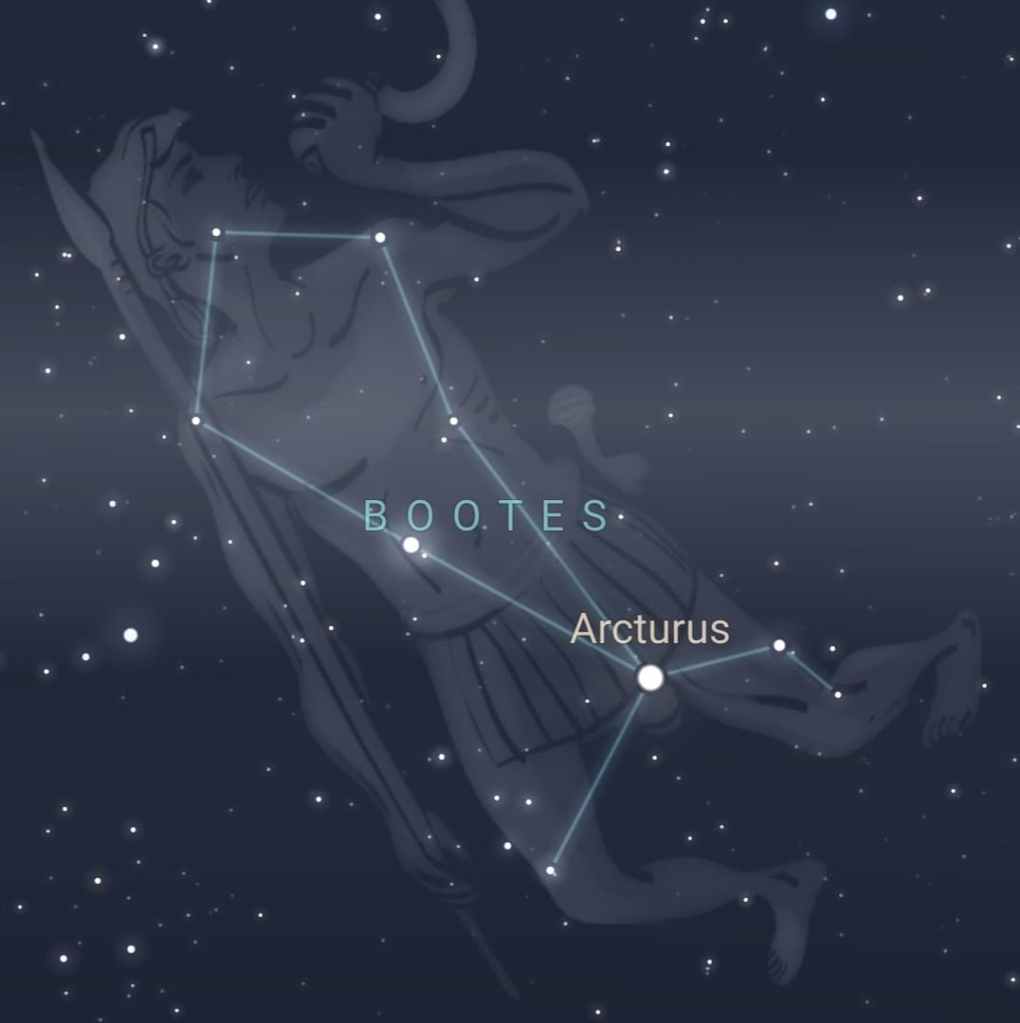
To find Boötes, use the handle of the Big Dipper. Follow the curve of the handle away from the bowl, and you’ll “arc to Arcturus,” the brightest star in Boötes. Arcturus is an orange giant star and one of the brightest stars in the night sky.
Boötes looks like a kite or ice cream cone shape, with Arcturus at the bottom.
Identifying Virgo the Maiden
Virgo is a large but relatively faint constellation. Its brightest star, Spica, is easy to find if you continue the arc from the Big Dipper’s handle through Arcturus and keep going. “Arc to Arcturus, then spike to Spica” is a helpful memory aid.
The rest of Virgo spreads out to the north and west of Spica, but its stars are fainter and can be challenging to see from light-polluted areas.
Finding the Spring Triangle
The Spring Triangle is an asterism (a recognizable pattern of stars) formed by three bright stars from different constellations:
- Arcturus in Boötes
- Spica in Virgo
- Regulus in Leo
Locating these three stars can help you orient yourself in the spring night sky.

Spotting Corvus the Crow
Near Virgo, you can find the small but distinctive constellation Corvus the Crow. It looks like a small, slightly lopsided square or diamond shape. Look for it to the southwest of Spica.
Identifying Hydra the Water Snake
Hydra is the largest constellation in the sky, stretching across a significant portion of the spring night sky. Its head is a small circle of stars located between Cancer and Leo. The rest of its body winds southward and eastward below Leo, Virgo, and Libra.
Fun Activities for Families
- Constellation Story Time: Learn the myths associated with each constellation and share these stories while stargazing. Encourage family members to create their own stories about the shapes they see.
- Star Hop Challenge: Create a “star hopping” game where family members take turns guiding others from one constellation to another using nearby stars as reference points.
- Constellation Drawing: Bring sketchpads and pencils to draw the constellations as you see them. Compare your drawings to official star charts.
- Seasonal Constellation Comparison: If you’ve observed the sky in winter, discuss how the visible constellations have changed with the season.
- Mythology Mix-up: Invent new stories that combine characters from different constellation myths.
Tips for Success
- Start with the brightest stars and most recognizable patterns, then work your way to fainter stars and constellations.
- Use your hands to measure distances in the sky. Your fist held at arm’s length covers about 10 degrees of sky.
- Don’t get discouraged if you can’t identify everything at once. Learning the night sky is a gradual process.
- Make stargazing a regular family activity. The more often you observe, the more familiar the patterns will become.
- Consider joining a local astronomy club for guided stargazing sessions and access to telescopes.
Remember, the joy of stargazing comes not just from identifying constellations, but from sharing the experience with loved ones and marveling at the vastness of the universe. Each time you look up, you’re likely to notice something new or see a familiar pattern in a different way.
As you explore the March-April 2025 night sky with your family, you’re participating in an activity that has fascinated humans for thousands of years. From ancient navigators to modern astronomers, people have always looked to the stars for guidance, inspiration, and a sense of our place in the cosmos.
So bundle up, head outside, and prepare to be amazed by the celestial wonders above. Happy stargazing!
Resources:
- Stellarium (https://stellarium.org/): A free, open-source planetarium software that allows you to see a realistic 3D sky on your computer.
- Sky Map (https://play.google.com/store/apps/details?id=com.google.android.stardroid): A free Android app that helps you identify stars, planets, and constellations.
- Star Walk 2 (https://starwalk.space/en): A paid app available for iOS and Android that offers an augmented reality star-gazing experience.
- NASA’s Night Sky Network (https://nightsky.jpl.nasa.gov/): Provides information about astronomy events and local astronomy clubs.
- International Dark-Sky Association (https://www.darksky.org/): Offers resources on light pollution and how to find dark sky locations.
- Astronomical Society of the Pacific (https://astrosociety.org/): Provides educational resources and activities for astronomy enthusiasts.
- EarthSky (https://earthsky.org/): Offers daily updates on what’s visible in the night sky.
- Space.com’s Night Sky (https://www.space.com/skywatching): Provides regular updates on celestial events and what to look for in the night sky.
These resources can help enhance your stargazing experience and provide additional information as you explore the wonders of the night sky.






 Stan's Hobbies and Interests