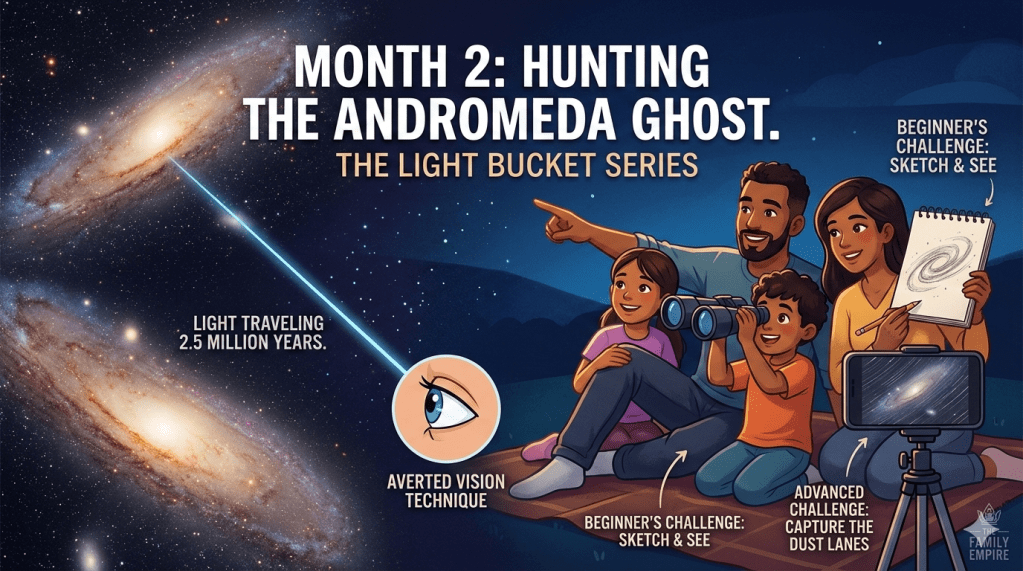
Welcome back to The Family Empire’s year-long journey through the cosmos! In January, we introduced the core philosophy of this series: The Camera as a Light Bucket. We learned that whether you are using your eyes, a smartphone, or a professional DSLR, you are essentially holding a bucket out in a “rainstorm” of light.
This month, we are moving from theory to the ultimate test. We are going to hunt for the Andromeda Galaxy (M31). This isn’t just another star; it is a “city” of one trillion stars, and it holds the title of the most distant object the human eye can see.
When you look at Andromeda, you aren’t just looking across space—you’re looking back in time. The light hitting your “bucket” tonight left that galaxy 2.5 million years ago. To put that in perspective, when those photons began their journey, our ancestors were just beginning to use stone tools.
The Newbie’s Guide: What is a “Deep Sky Object”?
If you’re new to the hobby, “Deep Sky” sounds like something from a sci-fi movie. Simply put, it refers to anything outside our solar system that isn’t a single star. This includes nebulae, star clusters, and galaxies.
Andromeda is our closest galactic neighbor, but because it’s so far away, its light is spread out. In a “Light Bucket” sense, the raindrops are falling very far apart. If you look directly at it, your eye might not catch enough “drops” to register an image. That’s why we use a secret weapon: Averted Vision.
The Science of Averted Vision: Your eye’s center (the fovea) is great for reading and bright light, but the edges of your retina are packed with “rods,” which are much more sensitive to low light. By looking slightly to the side of the galaxy, you’re using the more sensitive part of your “bucket” to catch the signal.
The Mission: Finding the Ghostly Smudge
Finding a galaxy for the first time is a rite of passage. Here is your family treasure map:
- Find the “W”: Look toward the North for Cassiopeia. It looks like a giant, slightly squashed “W” or “M”.
- Follow the Arrow: The right-hand “V” of the W acts like an arrowhead. It points almost directly down toward a bright star called Mirach in the constellation Andromeda.
- The Hop: Look just above Mirach for two dimmer stars. If you follow that line, you will see a faint, oval-shaped “smudge.”
Family Tip: Use a pair of 10×50 Astronomy Binoculars to make the “smudge” pop. Binoculars are essentially two medium-sized light buckets that make the hunt much easier for kids.
The February Challenges
We want everyone to grow this year, so we’ve designed two challenges to push your skills.
The Beginner Challenge: The “Sketch and See”
Your goal isn’t just to see it, but to observe it.
- The Task: Once you find the smudge, grab a piece of paper and a pencil. Try to sketch the shape.
- The Twist: Use averted vision. Does the smudge get bigger when you look away? Can you see a brighter core in the center? Sketching forces your brain to process the light more deeply, making your “internal bucket” more efficient.
The Advanced Challenge: Catching the Dust Lanes (Untracked)
For those who have a DSLR or a modern smartphone with a “Night” mode, your challenge is to capture the extinction of light.
- The Gear: A tripod is mandatory. Use a Basic Camera Tripod or a Smartphone Tripod Mount.
- The Task: Take a series of 1-second to 2-second exposures. Any longer and the stars will “trail” (turn into lines) because the Earth is spinning.
- The Goal: Stack these photos using free software like DeepSkyStacker. Your advanced goal is to reveal the dust lanes—the dark rings of cosmic soot that wrap around the galaxy. This requires your “bucket” to stay open for a long time (electronically) to gather enough light to see the contrast between the stars and the dust.
Why We Do This: The Family Empire Perspective
This hobby isn’t just about gadgets; it’s about perspective. Standing in the dark with your family, hunting for a light that has been traveling since before the Ice Age, reminds us how small—and how significant—we are.
As we grow this “Family Empire” together, we aren’t just learning to use cameras; we’re learning to appreciate the scale of the universe. It’s a hobby that grows with you. One night you’re looking at a smudge; the next year, you’re photographing spiral arms.
Gear Spotlight
To help keep our “Light Bucket” series running, check out these vetted tools for February’s hunt:
- For the Kids: Celestron Cometron 7×50 Binoculars — Lightweight and perfect for small hands.
- For the Beginner: Celestron AstroMaster 130EQ Telescope — A classic “Light Bucket” that will show you the core of Andromeda clearly.
- For the Aspiring Pro: ZWO Seestar S30 Smart Telescope — This all-in-one “smart bucket” does the hunting and the photography for you.
Next Month: Dealing with “Overspill”
In March, we turn our buckets toward the brightest thing in the sky: The Moon. We’ll learn what happens when our light bucket gets too much rain and how to handle contrast so we can see the jagged shadows of lunar craters.
Did you find the smudge? Tag us in your “Light Bucket” photos or tell us about your first Andromeda sighting in the comments!
 Stan's Hobbies and Interests